Ghost Mannequin Replacement With AI for Apparel Brands
Apparel brands choose between AI hollow-body and on-model generation workflows.
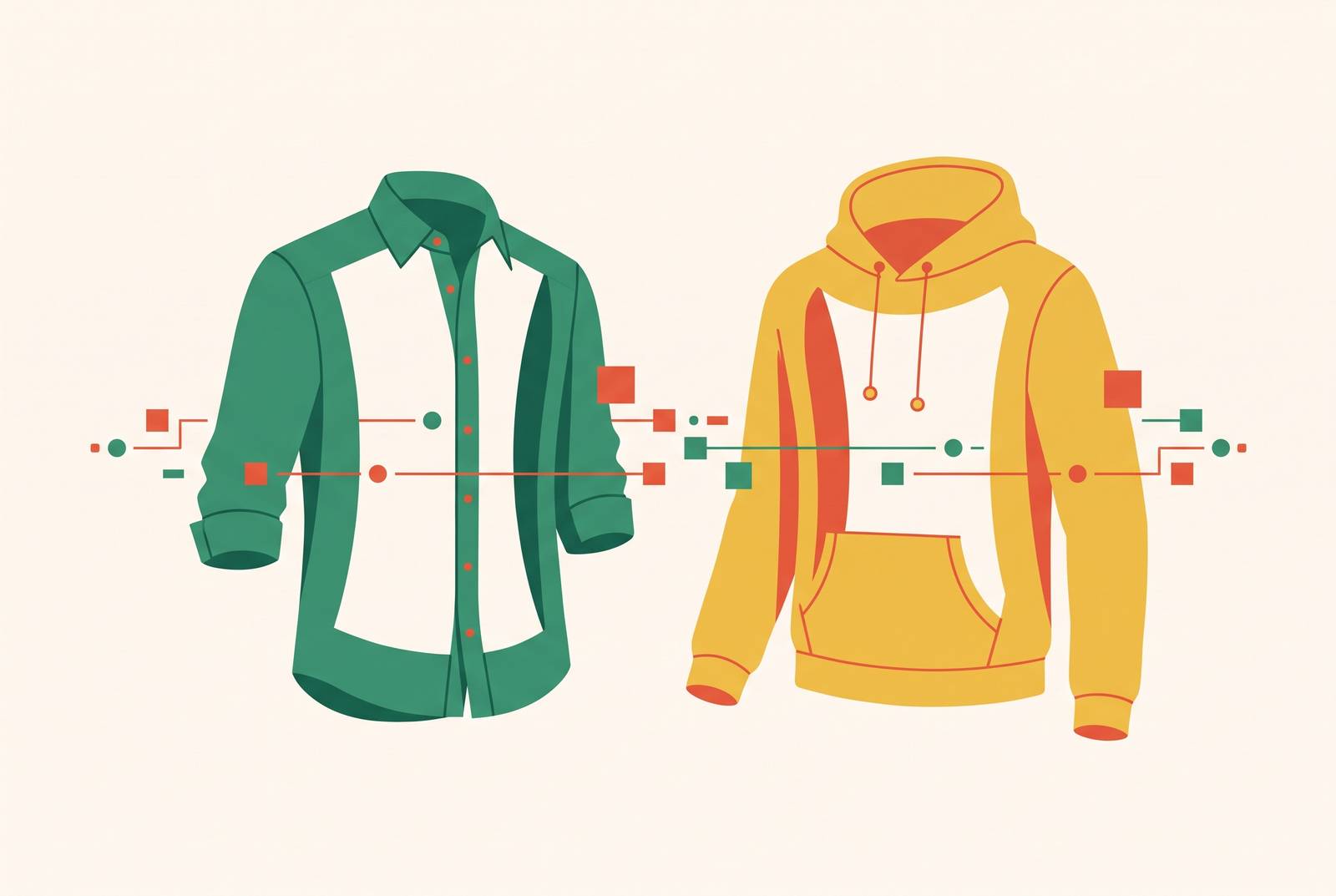
AI ghost mannequin replacement for apparel brands is a choice between two production systems. Hollow-body reconstruction preserves the product packshot, while on-model generation changes how the garment is presented. The primary output format determines the workflow a brand needs, from source photography and quality review to model rights and shared brand context.
Why the ghost mannequin workflow became a production bottleneck for apparel brands
A photographer shoots the garment on a mannequin, then photographs interior details such as collar linings, waistbands, and sleeve interiors. An editor composites the shots in Photoshop and masks out the form, which takes 15–25 minutes per image. Adobe Photoshop’s ~$20.99/mo subscription is therefore only the software cost. Photographer and editor time set the production ceiling.
Offshore clipping path services charge roughly $0.25–$7+ per image with 24–48 hour turnarounds, but outsourcing preserves the per-image production model. That model becomes a bottleneck when a brand with 800 active SKUs needs five body-type representations per product. Seasonal volume multiplies the work without shortening any individual production step. Yet the ghost mannequin format remains useful because it shows garment silhouette and fit without a visible stand. The pressure is therefore to change production without losing the presentation that a particular channel needs.
The core fork: hollow-body reconstruction versus on-model generation are not the same product
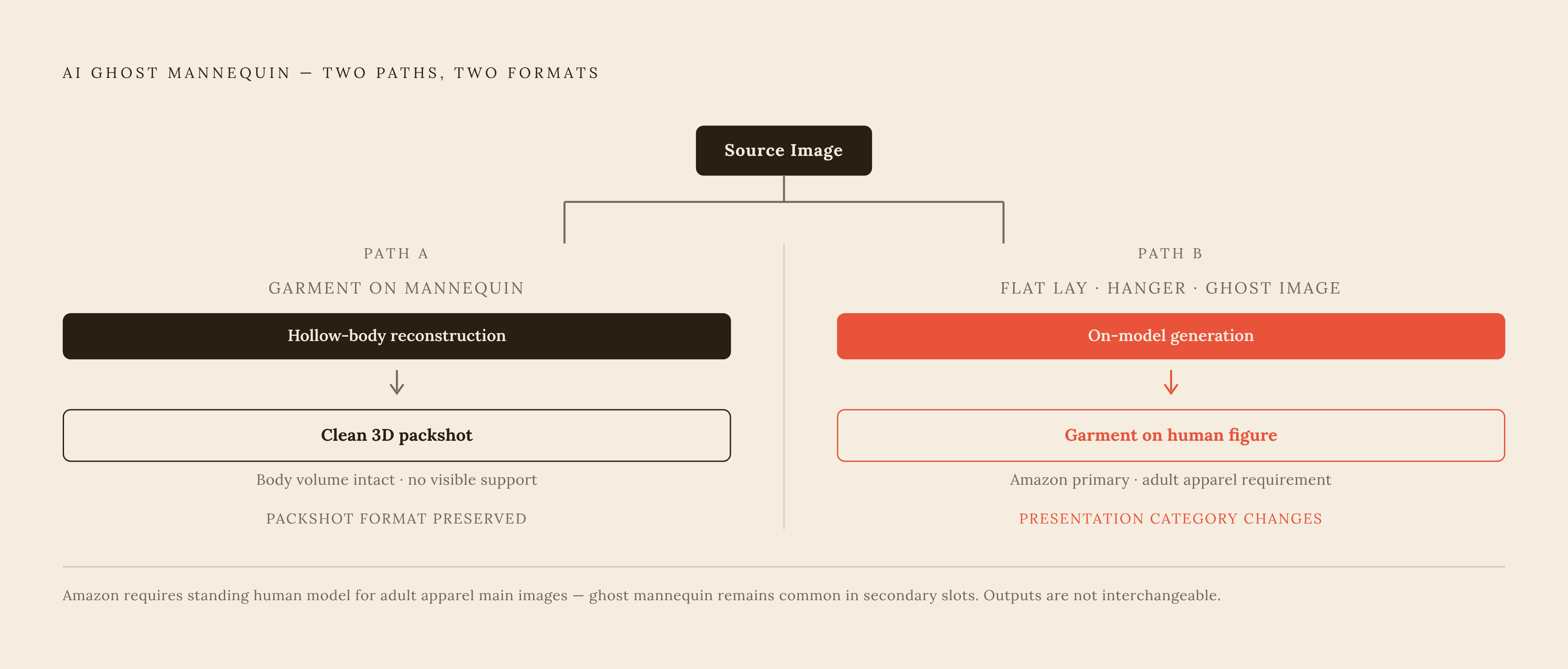
Hollow-body reconstruction removes the visible mannequin and reconstructs concealed garment areas, including inner necklines, linings, and seams. Its input is a garment on a mannequin or laid flat, and its output is a clean 3D packshot with body volume intact and no visible support. The result belongs to the same visual category as the traditional ghost mannequin image. AI changes the cost and speed of producing it.
On-model generation instead takes a flat lay, hanger shot, or ghost mannequin image and places the garment on a generated human figure. Picjam exemplifies this approach by converting those source photographs into realistic on-model product images.
A brand can use both approaches, and some platforms support both. WearView combines ghost mannequin removal with virtual try-on and AI model generation, while PixFocal produces ghost mannequin, on-model, flat-lay, and hanger outputs from one garment photo. That breadth does not make the outputs interchangeable. A brand still needs a primary deliverable because it determines shoot requirements, asset library structure, model consistency strategy, and marketplace compliance. Platform selection follows the format decision.
What hollow-body reconstruction tools actually do and where they break
The technical challenge begins with separating the garment from its background, but removal alone is not enough. The tool must reconstruct necklines, armholes, and torso shape with texture, drape, and lighting that match the visible exterior. Early tools produced obvious artifacts at these joins. Whether a tool accepts a second image is therefore an important input distinction, although most tools do not publish whether they accept a second angle. WearView explicitly supports front and back garment images, as well as flat-lay, hanger, and mannequin inputs, with results in under 15 seconds.
Photta offers 2K or 4K output, aspect ratio and background color parameters, batches of 1–10 garments depending on plan, and a documented ghost mannequin API endpoint. Photoroom places ghost mannequin processing in its standalone product, Batch, and Photoroom for Shopify, making native Shopify integration its notable distinction. Its ghost mannequin feature requires a paid subscription and AI credits. Pixelcut provides placement, aspect ratio, angle, background, and custom prompt controls in Product Studio, with output up to 4K.
Commercial models also affect how teams can evaluate the category. Snappyit lists monthly credit allowances starting at 120 credits and offers free credits for new accounts. PixFocal combines four output formats with 4K output, starting at $29/mo for 40 credits, and is free to try without a card. Musely.ai lets teams test it for free without signing up before they choose to pay. For operations that require guaranteed turnaround and human review, Pixelz combines AI with human editors, starting at $0.95/image plus $0.50 for invisible mannequin treatment.
These differences matter only within the quality limits of the garment itself. T-shirts, sweaters, and simple dresses follow predictable patterns, while sheers, structured tailoring, layered looks, and asymmetrical designs remain harder to reconstruct. Corrections can still be necessary around collars, sleeves, and overlapping fabric. Adobe Photoshop remains the fallback for pixel-level control on complex structured jackets, heavy knitwear, and multi-layer pieces, although Generative Fill can warp seams and the cleanest results still depend on layer masking. Pure AI reconstruction is sufficient for most e-commerce listings, but luxury fashion and strict photography guidelines can justify adding a human-reviewed quality gate to automatic output.
What on-model generation changes about the production workflow and catalog strategy
Mango photographed each real garment, then used those images to train a generative model that placed the clothing on AI-generated models. The setting read like a real shoot in the Medina of Marrakech, although both the models and location were synthetic. The garment photograph supplied the product evidence, while generation supplied the presentation. This separates physical garment documentation from the model and setting that appear in the finished asset.
That separation changes the value of an existing image archive. Picjam can use flat lays or ghost mannequin images to generate on-model versions at catalog scale without new shooting. The archive’s collection of finished packshots becomes an input library. Producing multiple body-type representations becomes a batch workflow. New upstream work can consequently center on clean flat lays or garment documentation.
However, generating a person is not the same as maintaining a model identity. Basic generators can produce a slightly different person each time, breaking the visual continuity of a collection. WearView keeps the same model identity across unlimited generations, so the same model can appear throughout the catalog. Academy Sports and Outdoors partnered with Stylitics and Stylitics AI Image Studio. The program simplified bundle and imagery updates, reduced manual effort, and established a consistent content-refresh cadence with less operational strain.
Channel rules still constrain the output strategy. Ghost mannequin images are still common on Shopify and in secondary Amazon image slots, while Amazon requires a standing human model for adult apparel main images. Brands serving different placements may therefore need both hollow-body and on-model assets. Multi-format production addresses that need, but the intended slot remains part of the production brief.
The labor and consent dimension that on-model generation cannot sidestep
Levi’s demonstrates why representation policy belongs inside the workflow decision. Levi’s announced that it would work with Lalaland.ai, a digital fashion studio, to increase diversity through AI-generated models. Critics objected that the brand was generating diversity synthetically instead of hiring and paying a more diverse real model roster. The backlash was immediate. Levi’s ultimately stated, “We do not see this pilot as a means to advance diversity or as a substitute for the real action that must be taken to deliver on our diversity, equity and inclusion goals and it should not have been portrayed as such”.
H&M planned to create 30 digital twins of its models, working with agencies and models, with the models owning the rights to their digital twin and receiving payment on each occasion of use. This consent-first structure drew far less criticism than approaches that buried consent terms in fine print. Being open about consent helps build trust as well as protect the brand legally.
Photographers, stylists, hairdressers, and make-up artists are not parties to the model’s digital twin licensing arrangement and do not share its payment structure. Fully synthetic models avoid the need to obtain consent to use a real model’s digital likeness, but they still expose brands to diversity-washing criticism when synthetic representation is presented as a substitute for real hiring. Brands using digital twins need clear contracts, rights to use them, and open disclosure of their use. These are tool and policy selection variables that hollow-body reconstruction does not introduce in the same way.
How to match the right approach to your catalog type, volume, and quality threshold
The choice depends on three linked needs: which output format to use, how complex the catalog’s garments are, and how many images to make while keeping them consistent. If a channel or catalog placement specifically requires a hollow-body packshot, reconstruction is the relevant branch. It is especially suitable when basic apparel dominates and an established shoot operation needs cheaper, faster post-production. For teams that work in Shopify at moderate volume, Photoroom’s native integration makes it easy to get started. Complex garments change that calculation because their correction burden can outweigh the convenience of automatic processing.
Quality thresholds then determine how much review the workflow needs. Brands with structured or layered pieces can budget for Photoshop as a fallback or use Pixelz for human-reviewed output on the pieces that matter most. For luxury brands and retailers with strict photography guidelines, the human layer acts as a quality gate. Its value is the review step between generation and publication when a failed image carries real cost.
On-model generation is a good fit when on-model imagery gets more engagement on a brand’s DTC channels and the brand already has suitable source photographs. It also suits collections that need the same model identity without repeat casting, or broad representation without having to plan a new shoot. WearView, from $29/mo, covers both reconstruction and on-model generation for brands maintaining both formats. The representation strategy remains subject to the consent and transparency choices described above.
PixFocal’s four output types from one garment photo provide an architecture for maintaining both product-only and on-model assets without separate source libraries for each format. At that point, developer access becomes a workflow variable. Photta and Photoroom document ghost mannequin API endpoints, while Pixelcut’s ghost mannequin feature is app-only and is not documented as an API endpoint. TheNewBlack also provides programmatic access to studio workflows, so brands building proprietary commerce infrastructure should weigh API quality heavily.
Why brand consistency breaks down when AI image tools operate without shared brand context
Selecting the correct image tool does not resolve the problem of shared brand direction. Each tool can still operate with its own isolated copy of the guidelines. When team members manually paste color palettes, model aesthetics, background styles, and tone into prompt fields, each version can differ slightly. Across a large catalog, those differences add up until the images look inconsistent. A tool can get the format right and still get the brand’s look wrong.
Guideline updates make this fragmentation harder to control. A revised seasonal palette or model aesthetic has to reach every downstream tool, or old and new directions coexist in the catalog. An agency that manages ten brands across several image tools also has to keep those brands separate. Manual context management does not scale to that task. The missing infrastructure is machine-readable, versioned context containing guidelines, visual references, approved assets, model aesthetic parameters, and voice specifications.
An AI agent comparing products for a customer reads structured attributes such as fabric, fit, measurements, stock, delivery time, and return policy. Thin or inconsistent product attributes can remove a brand from consideration regardless of image quality. Shared context is therefore becoming a commerce prerequisite. The visual production system and the information available to agents both need coherent brand and product inputs.
Bloom addresses the brand-context layer by ingesting existing guidelines, files, design systems, and social profiles into a structured Brand Skill. Connected AI tools and agents can retrieve that context through API or MCP, so image tasks begin with the same canonical source. Teams managing multiple brands work in one workspace with structural separation between brands. This gives the chosen production system a shared foundation, so selecting the right format leads to a consistent catalog.