AI Creative Workflow Toolstack for Small DTC Teams
A brief-generate-review loop keeps AI creative on-brand.

The right AI creative workflow toolstack for small DTC teams enforces a repeatable brief-generate-review loop. Detecting when AI output drifts off-brand requires checking logo usage, type, colors, imagery, voice, claims, and product accuracy against shared, versioned brand context. Each check should say what it found, and a human should decide whether the asset is ready for its intended campaign placement.
Why small DTC teams hit a creative limit even after adopting AI tools
Small DTC teams in 2026 can have generators without having a system for producing work. One person tests an image model, another uses a video tool, and a freelancer delivers files from a third platform. Generation works, but approval remains unclear. Without a common brief or visible asset status, the team cannot reliably distinguish an experiment from work that is ready for paid media.
With that gap, low subscription prices tell little of the full cost of AI creative. The expense appears downstream in review time, rework, inconsistent assets, and rejected ads. It also affects analysis. When every asset was created differently, campaign results become harder to interpret because creative differences are not part of a controlled test.
What the brief-generate-review loop actually is and why the order is non-negotiable
The loop separates creative decisions into three sequential phases with distinct owners and outputs. The brief owner defines the product, offer, audience, channel, and commercial goal before generation begins. An AI operator then creates the first batch using saved prompts and brand inputs. Review follows against those requirements. A brand reviewer checks visual consistency, claims, product accuracy, and tone, while a campaign owner approves the asset for a specific placement and tracks performance.
Without that sequence, the reviewer must reconstruct the intent after the work exists, turning approval into a second briefing exercise.
AI makes this division of responsibility more important because cheaper production increases the burden of selection. Generating fifty caption variations takes a lot of output but little judgment, so an agent should do that work. Deciding which three fit the brand and warrant real spend is a human taste call with money attached. Status makes that decision visible to everyone else. Every asset should be marked draft, needs edit, approved for test, approved for campaign, or retired, even when the workflow is only a checklist in Notion, Airtable, or Trello.
How to build the brief layer with structured brand context that travels with every task
An AI-scale brief is a task-specific output drawn from structured brand context. That work should be grouped by the type of campaign. Recurring tasks include product launches, clearance sales, bundle promotions, seasonal collections, abandoned cart campaigns, landing page heroes, and paid social tests. Each needs a reusable brief template suited to its purpose. This gives the team a repeatable starting point without treating every campaign as the same creative problem.
The underlying context must contain the standards those templates draw on, including logo usage, type, colors, imagery rules, voice rules, and channel specifications. The brief selects what applies to the task. A generic paste of the full brand deck does not make that selection clear. Requirements for the task tell the operator what must stay the same as they generate other options. Once a template has been validated against a campaign type, it becomes a reusable production asset, supported by saved prompts that can be reused every week.
The brief also defines what the campaign will test. ugcad.ai’s 2026 DTC UGC playbook introduces Creative Testing Velocity as structurally distinct angles tested per month divided by total monthly creative spend in hundreds of dollars. A distinct angle changes the hook, proof mechanism, or framing. The brief needs to distinguish structurally distinct angles from surface variation, such as a different avatar delivering the same script, because surface variation is the single biggest cause of failure in AI UGC testing, and a well-designed test requires that distinction before review.
Why brand context needs to be shared infrastructure, not a file each agent gets separately
Reusable briefs still depend on agents receiving the same underlying standards. When each agent reads its own isolated copy, brand context becomes fragmented across prompts, tools, and sessions. Agent memory is transient, so an agent without persistent shared context starts fresh. When the brand changes, each copy also needs to be updated on its own. In a multi-agent production pipeline, this context inconsistency is a primary cause of drift, rather than a problem that a more capable generator alone can solve.
Shared context addresses that failure at its source. Brand standards are stored once, versioned, and queried by every connected agent, so an update propagates without manual changes to every prompt and session. Model Context Protocol, or MCP, provides a standard pattern for connecting agents to tools and shared data. By Q1 2026, OpenAI, Google DeepMind, and Microsoft had adopted it natively, with Cloudflare serving as a key MCP infrastructure platform. MCP SDKs reached 97 million monthly downloads by April 2026.
Adobe Marketo Engage launched its MCP server in April 2026 with operations across forms, programs, smart campaigns, leads, emails, snippets, lists, and folders. Klaviyo has an MCP server for real-time analytics queries, campaign creation, flow management, and other marketing actions. Meta announced Ads AI Connectors in April 2026 with MCP and an Ads CLI as its two integration methods. Those integrations allow compatible AI assistants to create campaigns, adjust budgets, manage targeting, query performance data, and manage catalogs from a conversational interface.
Connectivity alone does not provide brand governance. MCP can impose significant token overhead compared with direct CLI execution, and reliability can fall as the number of exposed tools grows. The system should connect agents to one brand context layer with rules for how it is managed, while limiting which tools they can access at once. The integration protocol supplies access. The shared context supplies the standards that make that access useful for consistent creative production.
The generation layer and where each tool category fits in the loop
Generation tools execute the brief for a particular output type. Product image generation, for example, can place a product into different environments while rendering shadows and reflections, processing a catalog in batches, and applying brand style presets. StudioTools.ai describes these capabilities in its 2026 DTC guide. The preset layer is where the brief’s visual rules become generation inputs. Its role is to keep the images visually coherent.
Seasonal refreshes can move the same source image into a summer kitchen, autumn table, or winter gifting setting. New SKU launches can use multiple scenes and formats within hours of receiving the physical unit. Audience segmentation can place the product in a minimalist apartment or a warm traditional setting. The context changes for a stated campaign reason. That distinction keeps environmental variation tied to the brief rather than treating every new background as a new creative strategy.
Video and AI UGC serve a different production need. Tadka’s 2026 DTC ad creative guide positions Creatify as the stronger choice when video UGC is the primary format, while positioning Tadka around volume and brand consistency for image-first teams. Reusable footage is another part of this layer. FabFitFun went from 100 videos per quarter to 400 after implementing a modular, tagged library that let editors reuse footage from winning ads. Before Recharm, its editors spent roughly two hours locating a single clip before editing could begin.
AdSkate’s MCP integration lets advertisers test campaign creatives against large pools of synthetic audiences conversationally, simulating response patterns before real media spend. That evaluates a different question from brand compliance. An asset can generate a promising simulated response while still requiring checks for product accuracy, voice, and placement suitability.
How do teams detect when AI output drifts off-brand during review?
Off-brand output is not limited to an obviously wrong logo or color. Detection signals include incorrect type, imagery that violates brand rules, inconsistent voice, unsupported claims, misleading product details, and assets unsuited to the intended placement. Attractive output can still fail these checks. A lifestyle image may look high-end but promise more than the product can deliver. A paid ad may also draw the wrong buyer, so campaign numbers look good even as margin falls.
Product accuracy requires particular attention in DTC review. Misrepresented texture, size, packaging, color, or included accessories can create refund pressure and support tickets. These are not merely aesthetic disagreements with a brand reviewer. They concern what a customer believes is being sold. A systematic audit must therefore assess the product representation as well as the visual style, rather than approving an image because its composition and palette look persuasive.
The practical audit system is a structured checklist anchored to the brand context used for the brief. Each check should return a specific finding. Logo usage, type, colors, imagery rules, and voice need evidence that a reviewer can act on, rather than an overall impression that the work feels close enough. Claims, product accuracy, and placement suitability require the same treatment. The resulting findings support a defensible asset status and distinguish work needing edits from work approved for testing or campaign use.
Shared context lets automated checks use the same requirements for the audit that were used to generate the work. The reviewer is not applying a separate interpretation of the brand after production. Human judgment still governs the commercial choice. Review must also preserve enough consistency for A/B results to remain readable, since ads that differ in every respect and landing pages that continually shift tone make attribution harder.
How the layers connect into one operating system for DTC creative
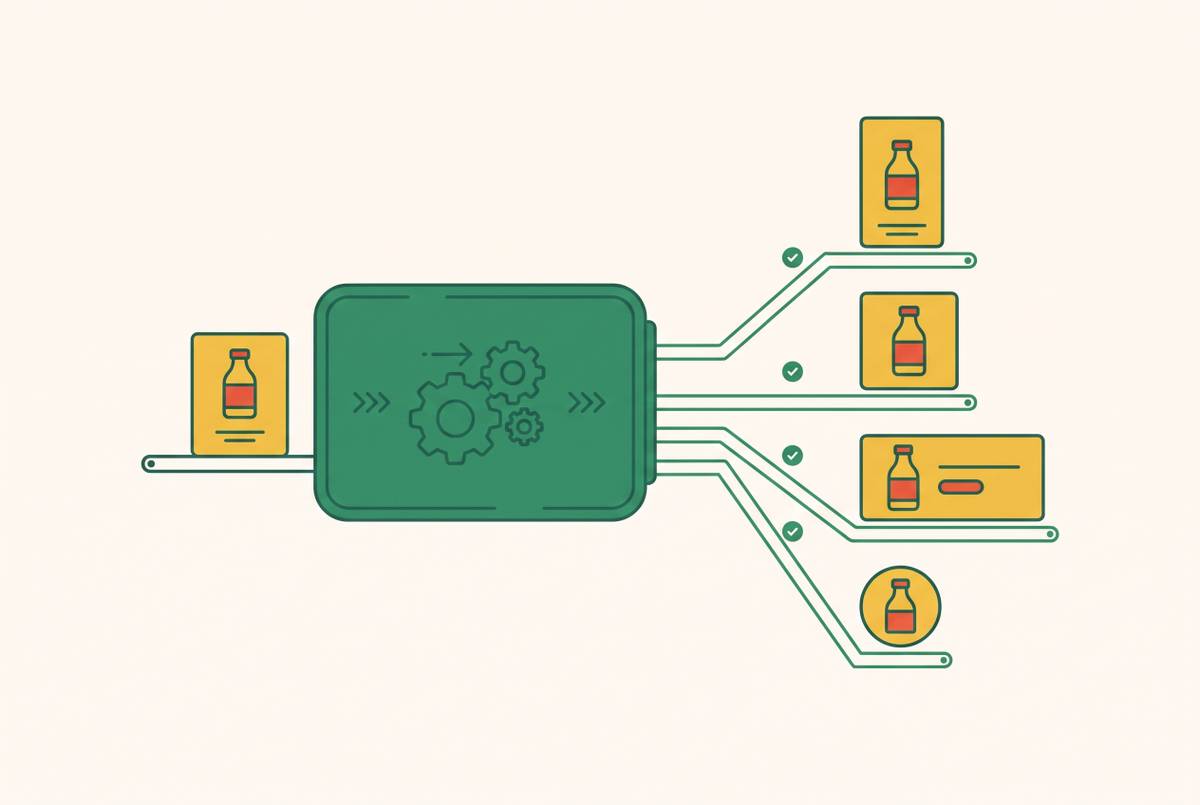
The connected stack begins with versioned brand context and uses it to produce a campaign-type brief. That brief selects the logo, type, colors, imagery, and voice requirements relevant to the task. Image, video, UGC, and modular clip tools then make options that follow those rules. Review checks the finished work against that same context before it ships. Each layer depends on the one before it, while the shared context prevents the handoffs from introducing different standards.
Multi-brand and agency operators can maintain separate brand contexts within the same infrastructure and apply the same production discipline to each. The operational structure does not need duplication. How well it works should be judged by Creative Testing Velocity, rather than just how much it produces or the cost per video.
Brief templates and the review checklist provide the practical starting point. Those define the standard that every generator will be held to, so they have greater leverage than adding another source of unreviewed variation. Shared brand context then connects that standard across agents and tools. The operational advantage comes from those enforced handoffs, which make each additional tool productive within a disciplined system.