Building an Off-Brand Output Catch Into the Last Mile of Your AI Creative Pipeline
A final check after channel adaptation catches off-brand AI output with evidence.

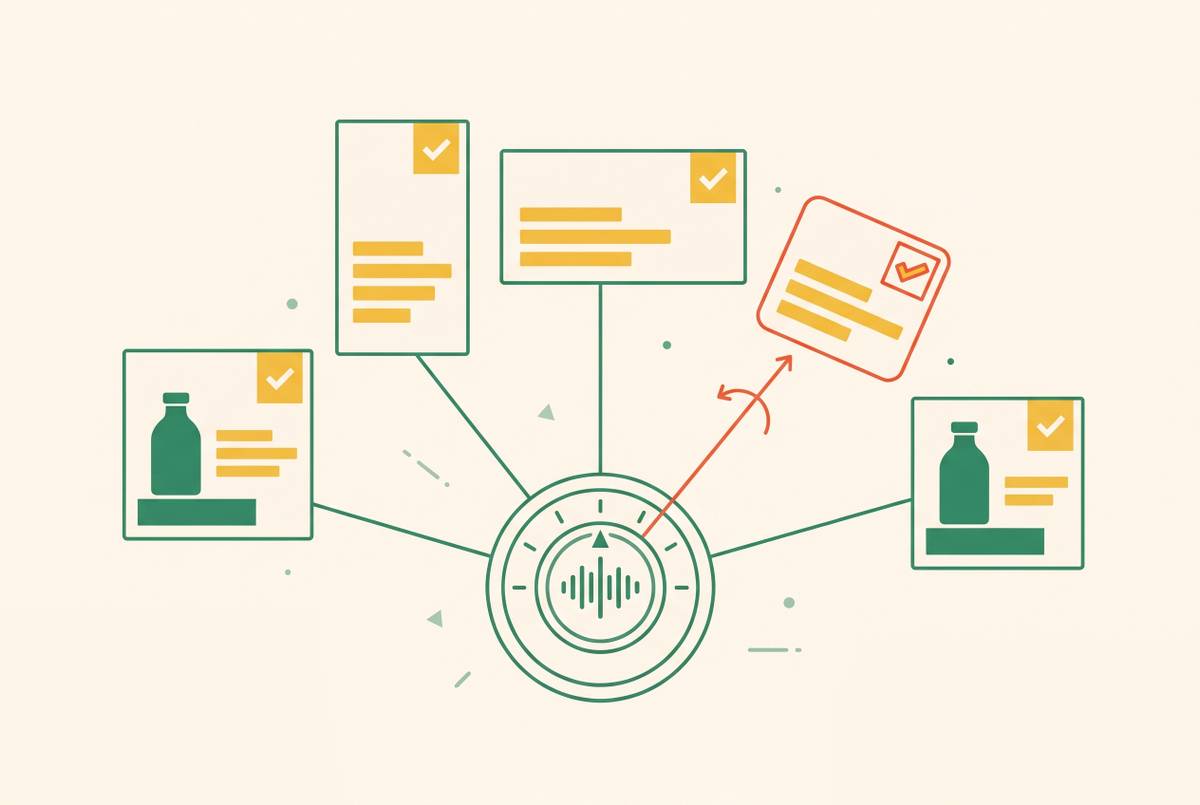
Detecting when AI output drifts off-brand requires a discrete, engineered check stage after generation and channel adaptation, before scheduling or publishing. That stage must check finished creative against the brand’s specific rules and show the evidence for each finding. Human review remains necessary for higher-risk work, but it cannot be the primary gate across an automated creative pipeline.
Why human review can no longer serve as the primary brand-consistency gate in AI creative pipelines
A campaign can involve dozens of assets, multiple channels, and external partners working from outdated PDFs. When demand outpaces design capacity, non-designers and regional teams produce work outside the brand system. Each new producer is another person who may lack the current rules or read them differently. An approval process in which designers inspect each asset cannot reliably check work made outside that process.
Agentic systems deepen the mismatch because they automate tasks and decisions. Generation, channel adaptation, and scheduling can happen faster than the approval loop was designed to handle. In multi-brand and agency environments, speed also exposes a separation problem. Without hard boundaries, an agent’s context can bleed from one client into another.
Small teams are not insulated from this gap. Agentic tools make generation cheaper, so output can grow before governance catches up. A modest production volume can therefore conceal the need for an engineered gate until generation expands.
What makes brand drift in AI output different from traditional inconsistency
Human inconsistency often involves someone overlooking or misapplying a rule they could have consulted. AI-generated drift has a different root cause when agents lack reliable access to brand rules at generation time. A PDF does not supply that access by itself. Agentic tools need structured inputs, tokens, schemas, and explicit rulesets rather than a document that depends on a human translator. Without those inputs, repeated generation can reproduce the same departures from the brand.
Prompt variation adds another source of divergence. When each team member expresses the brand in slightly different language, each prompt becomes a separate interpretation of its identity. Those differences in wording build on each other across campaigns. More review rounds may catch individual examples. They do not remove the inconsistent basis on which the next outputs will be generated.
Similar tools, prompts, and training data can make different brands converge, with logos that look alike and copy that sounds alike. An asset can appear polished while losing the distinctions that make it recognizably part of a particular brand. This is a repeatable failure in how brand intent reaches the system, which explains why better-looking output is not necessarily more faithful output.
Why the review stage belongs at the end of the pipeline, not upstream in the brief
A structured brief reduces drift, but it cannot establish that the finished asset complies with every relevant rule. Generation introduces variability that the brief cannot fully specify in advance. Strong upstream direction is necessary but not sufficient. The terminal check evaluates what was actually produced rather than assuming that the instructions survived every transformation.
In Superside’s three-stage model, strategic direction comes before generation, experts curate the work after it, and people refine it before delivery to meet brand standards and legal requirements. Upstream context and final review coexist because they serve different purposes. One guides production, while the other assesses its result.
Channel adaptation makes that distinction especially important. Aspect-ratio changes, channel specifications, and dynamic content injection happen after the brief and can introduce visual inconsistencies. A check that runs before those changes cannot tell what they do to the asset. The last-mile gate therefore belongs after adaptation, where it can examine the asset that is about to ship.
How to detect when AI output drifts off-brand
The working specification should cover four distinct categories, which are visual brand drift, voice and tone compliance, asset and component integrity, and compliance flags. Each category needs its own evidence output. A single general judgment of whether an asset “looks on-brand” cannot substitute for these checks because they evaluate different properties. The gate must distinguish a measurable design mismatch from a language violation, an unapproved component, or a missing disclosure.
Visual verification should compare approved color values, typographic scales, spacing units, and logo treatments against the brand’s design system. Approximate resemblance is not the acceptance criterion. Design tokens make the required values explicit, allowing the check to compare the asset with the specification. A color mismatch can therefore identify both the observed value and the required token value.
Voice and tone checks should evaluate approved vocabulary, banned phrases, target reading level, and the right persona for the channel. These requirements need to be set out in structured voice schemas as well as prose descriptions. “Friendly but professional” is not a checkable rule. Vocabulary lists, rules on which phrases to avoid, and reading-level targets give the stage clear ways to check voice across outputs.
Asset and component integrity requires a separate check of provenance and permitted use. Images, logos, and templates should come from approved libraries with the correct usage-rights and channel metadata. Components should be approved building blocks from the living design system. A visually correct asset can still fail this check. Static templates may keep an old design even after the current system has changed.
Compliance flags should evaluate machine-checkable rules for regulated claims, regional restrictions, and required disclosures. This evaluation is limited to structured rules. New York’s Synthetic Performer Disclosure Law, which takes effect on 9 June 2026, requires ads to disclose when they use AI-generated performers. Such requirements belong in the gate as explicit conditions for the relevant asset.
How to structure the evidence each check returns
Every finding should return four fields, namely the specific rule checked, the value found in the asset, the value required by the brand specification, and the confidence level of the check. Pass/fail alone does not support decisions at volume. Without evidence, a reviewer must reopen the asset just to see why it was flagged. The finding should contain enough information for a downstream routing decision without repeating the inspection.
For a background-color mismatch, the rule field identifies the background-color requirement, the observed-value field contains #E8E8E8, and the required-value field contains #FFFFFF. The fourth field records the check’s confidence level. This separates the rule from the observation and makes the discrepancy explicit. It also avoids presenting a confidence judgment as though it were the brand requirement itself. A non-designer can interpret the finding without guessing what the system objected to.
That structure supports routing to auto-approve, auto-fix, escalate, or reject. It does not make every finding equally suitable for automation. Instead, the evidence supplies the basis for choosing a path while reserving creative-director attention for decisions that require it.
Google AI Brief illustrates the related principle of making interpretation inspectable before deployment. Its live previewer plays back how submitted guidelines translate into proposed ad copy, search queries, and audiences before ads are shown. For an internal check stage, the corresponding requirement is evidence that exposes how the rule was applied. Reviewer decisions, annotations, and accumulated feedback can then serve as training data that improves the system’s understanding of the brand over time.
Risk-tiering assets before they reach the check stage
A resized social reformat of an approved asset does not need the same treatment as a new campaign image for a regulated product targeting multiple jurisdictions. Giving both a full-depth review wastes time on the reformat and slows the whole pipeline. Applying only light review to both leaves the riskier work underexamined. Tier assignment therefore needs to be an explicit pipeline design decision.
The low-risk tier should cover high-volume reformats and template-fills, with automated token-level checks and no human step. These assets still pass through the gate.
The middle tier should cover new copy and new visual concepts, combining automated checks with designer batch review. The high-risk tier should cover regulated claims, multi-jurisdiction work, and flagship campaigns, with the full check and a named person who signs off.
Without tiering, review capacity can concentrate on assets that need it least. At the same time, assets that need a close look may take the same light-touch path as routine reformats. The purpose of the three-tier structure is to match scrutiny to risk without turning the universal gate into a universal bottleneck.
Wiring the check stage into the pipeline: where it sits and what it connects to
The check stage should run after generation and channel adaptation, before any scheduling or publishing agent receives the asset. Its position must be enforced by the workflow. A manual trigger or optional review request leaves a route around the gate and does not constitute a last-mile control. Operationally, every asset passes through the stage, its checks return structured findings, and its pass/fail output gates the next step.
The stage should read the same versioned brand system used by the generation agents. A separately maintained QA ruleset can diverge from production guidelines, leaving the two stages to apply different definitions of correct output. Shared context avoids that split. The source should include the design tokens, voice schemas, compliance flags, and approved asset libraries needed by both generation and review.
MCP, or Model Context Protocol, provides one integration path. An MCP server can expose those resources through a shared endpoint that generation agents and the check stage can query. MCP’s official documentation describes it as an open standard for connecting AI applications to external systems.
Webflow’s native MCP server provides a concrete production example. Agent Instructions can supply connected agents with design-system, voice-and-tone, CMS, and policy context stored with the site, with sharing available across a workspace through Shared Libraries.
A REST API is the alternative for teams building the check into their own product. It can expose the same brand context as structured data queryable at generation and review time. The integration path does not change the gate’s responsibility. Whether connected through MCP or a REST API, the stage must evaluate the finished asset automatically and control whether it proceeds.
Keeping the check stage current when the brand changes
A static ruleset becomes a liability as soon as the brand changes. It can check new work against an old rule even while generation follows the new direction. Brand context needs version control as well as replacement documents when the brand changes. When a color token changes, every connected generation agent and check stage should read the new value automatically, without waiting for someone to update a separate QA document.
That propagation must cover review as well as creation. Versioning provides a shared basis for the change. It also supports seeing who changed what, rolling back to previous versions, and maintaining separate template sets for sub-brands or campaigns. The rules read by the check stage need the same discipline as the production templates.
For agencies and multi-brand operators, each brand’s context should be kept separate and have its own version history. An update to one brand must not silently change another brand’s check rules. Separation is part of correctness because a checker with precise rules still fails its purpose if those rules belong to the wrong client.
The closed loop is complete when brand context supplies both generation briefs and the terminal check’s ruleset. Reviewer feedback improves the system’s understanding, while approved brand changes propagate to generation and review from the same commit. Keeping those paths joined keeps the last-mile catch current as an integrated component of a living brand system.