Versioned Brand Identity as a Shared Dependency Across Every DTC AI Workflow
Why one governed brand source beats prompts for keeping agents on-brand.
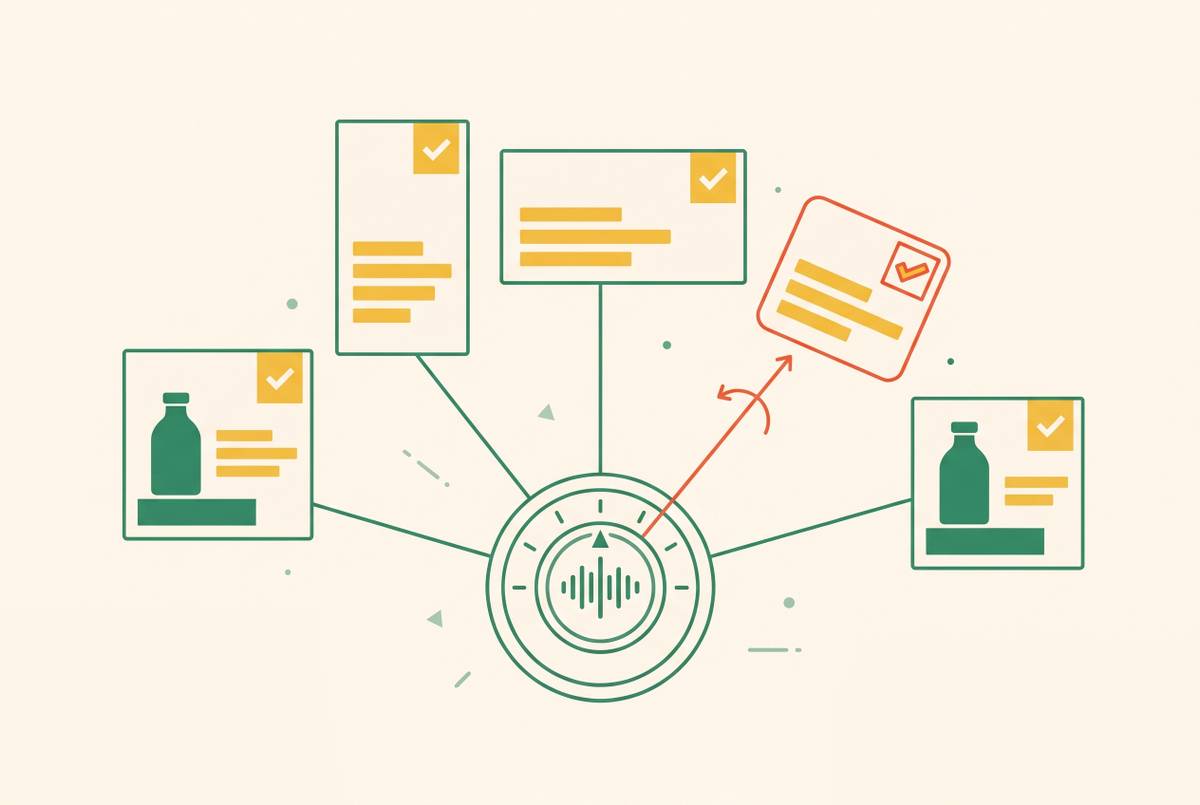
To spot when AI output drifts off-brand, it needs to be checked against clear, current brand rules, even when it sounds plausible. For DTC brands running multiple agents, the durable fix is a versioned shared dependency that supplies the same governed identity to every workflow. Better prompts cannot keep isolated copies of brand guidelines synchronized.
Why DTC brands running multiple AI agents don't have a prompt problem
A DTC marketer may have several agents running in parallel, each seeded with a slightly different paste of the brand guidelines. One writes campaign copy, another makes visual assets, and another checks content before review. Their instructions do not share a common foundation. What agents know about the brand is still spread across PDFs, Notion pages, and Slack threads, so each works from whichever piece reached its prompt.
Each workflow run creates another opportunity to deviate, so increasing workflow volume multiplies those opportunities unless the probability of a defect falls proportionately. Isolated copies have no way to make defects less likely. A carefully written prompt can improve one agent’s instructions, but it cannot update the instructions held by every other agent.
The diagnosis is dependency management. AI-generated content is not inherently off-brand, just as human-generated content is not inherently on-brand. The distinction is whether the creator works from a governed source of truth. Software teams address an equivalent problem through versioned libraries held in a package registry, where services share a maintained dependency.
Detecting when AI output drifts off-brand across a multi-agent DTC stack
Non-designers and regional teams build from outdated templates, interpreting loosely because their guidelines PDF is months old. Agencies and freelancers may hold a different snapshot, creating another branch of divergence. Brand instructions split further when teams rush to fit work into a LinkedIn carousel or an Instagram Story without first deciding how the brand should work in each format.
Shadow AI makes these branches harder to trace. A product marketer needs a hero image for a landing page and does not want to wait for the creative queue. A personal AI tool lets the marketer skip that wait. The image then reaches customers without brand context or a governed workflow, even though the marketer only wanted to finish a task faster.
The resulting inconsistencies are not limited to clear violations. Two agents can interpret loose guidelines differently and produce contradictory outputs without either obviously breaking the original wording. Each additional agent creates another branch, while the possible contradictions between pairs grow faster than the agent count. Detection therefore needs to consider disagreement across outputs as well as departures from individual rules. An About page describing a “luxury wellness brand” and reviews describing a “budget supplement” illustrate the wider risk, because conflicting descriptions weaken the brand’s AI-readable signal as well as its coherence for customers.
What a versioned shared dependency actually means for brand identity
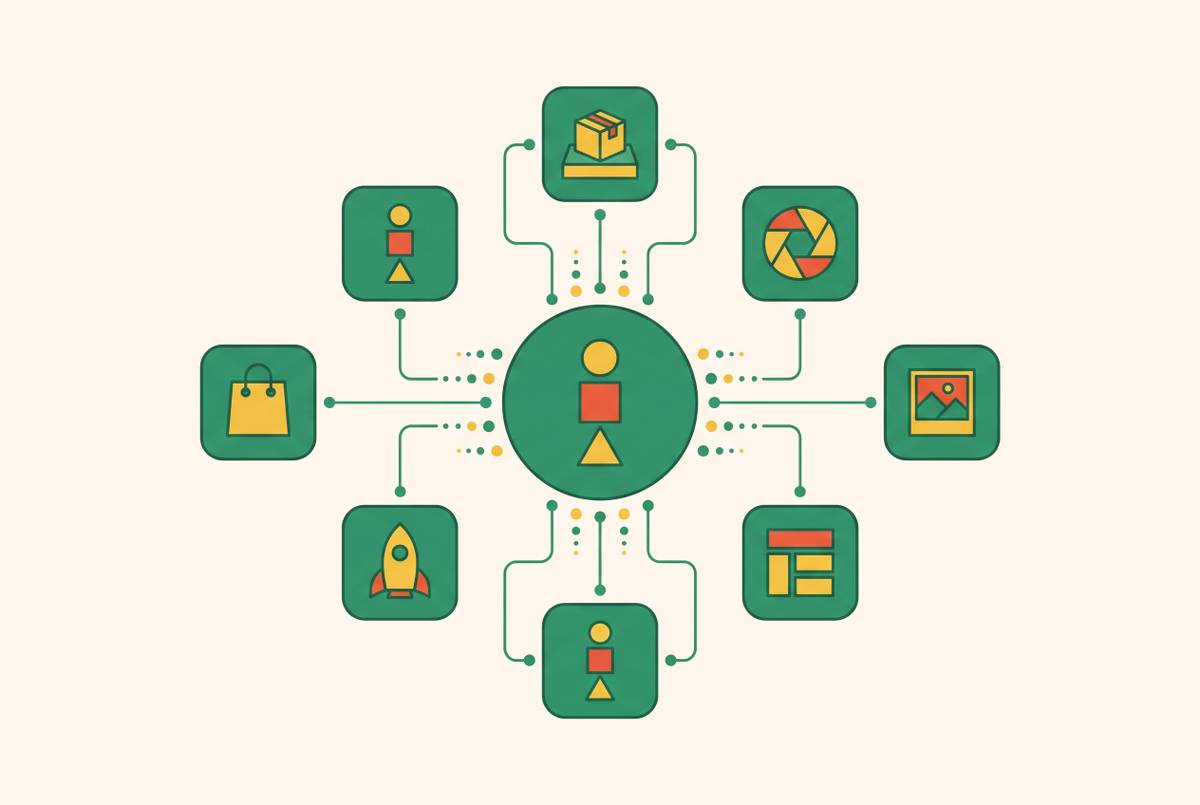
A versioned shared dependency puts brand identity in one governed place, makes it queryable, and propagates changes to every connected agent. It replaces copied instructions with a maintained source. The analogy to a package registry is useful because it separates the identity itself from the tools that consume it. Agents can do different jobs while using the same approved definition of the brand.
That requires a change in the format of the guidelines. A 60-page PDF serves a human reader, while a machine-readable brand kit gives an agent named values and rules it can apply. Visual identity becomes design tokens covering colors in HEX/RGB/CMYK/Pantone, spacing, and typography. An update to a shared token then governs future assets without requiring someone to replace the value in each agent’s prompt.
Voice needs the same degree of precision. “Sophisticated” leaves room for incompatible interpretations, whereas sentence length limits, excluded buzzwords, and required terminology create testable constraints. Rules for composition and photography likewise move from descriptions of mood to mathematical ratios, depth-of-field parameters, and lighting models. The same rules guide how work is made and reviewed. They also make a deviation specific enough to discuss and correct.
Versioning gives that shared definition a controlled history. Templates record who changed what, support rollback, and maintain separate sets for sub-brands or campaigns. A refreshed palette, product-line tone, or campaign logo variation can therefore become an explicit change rather than an informal exception passed between teams. Component library sync, token-based styling, and version-controlled templates make up a living design system. Without propagation, however, even a well-maintained version history leaves agents working from old instructions.
Why MCP is the delivery mechanism that makes a shared brand layer agent-agnostic
Model Context Protocol (MCP) gives compatible agents a standard interface to query brand identity before they make content. The shared layer need not belong to one model. Whether agents run on Claude, ChatGPT, or Gemini, an MCP server exposes the same brand context through a common protocol rather than requiring a separate integration for each tool.
This changes how instructions reach the workflow. A prompt depends on someone remembering to enter the right information in the right tool at the right time. An MCP connection lets the agent query the source autonomously before acting. The governed source still defines the rules.
The MCP specification’s July 2026 update made the protocol stateless, with each request including its protocol version, client info, and client capabilities independently. This matters when brand servers receive requests from many agents at the same time. Each request contains its own protocol context. For a shared brand layer, this supports a model in which multiple consumers can query the same infrastructure without the protocol depending on a persistent session.
Meltwater has exposed its Mira API and broader data through a remote MCP server, Meltwater MCP, illustrating the protocol’s use as an integration layer for agent ecosystems. It is an adoption signal. Within a brand deployment, marketers also control how available capabilities are described in metadata. Those descriptions influence how agents select capabilities and explain their actions, making their wording a brand voice decision as well as a technical one.
How a multi-agent DTC stack coordinates when every agent draws from the same brand source
A Researcher Agent surfaces trends, a Copywriter Agent drafts assets, and a Compliance Agent checks brand safety. Each works on its own but queries the same context before it acts. Their responsibilities differ. Their reference does not. Coordination can then focus on the division of work rather than reconciling conflicting brand instructions.
The emerging Brand Guardian Agent pattern adds a specialist reviewer that runs in parallel with the other agents. It evaluates their content against the shared brand context and flags deviations before a human reviewer receives the work. Its role is distinct from drafting. Explicit constraints make that role concrete, because an excluded buzzword, incorrect token, or departure from required terminology can be evaluated against an approved rule.
Multi-brand operators and agencies can use the same architecture with a separate context for each client or sub-brand. Each context has its own versions, while agents draw from the appropriate one for the job. Brand separation becomes part of the workflow. New clients can then be added without someone copying instructions by hand, and each brand keeps its own identity.
Adobe describes a central content supply chain of approved assets and guidelines as the way to keep brands consistent in agentic workflows. That shared foundation connects campaign speed to brand coherence, but only while the agents receive current information. If the source changes while agents keep using disconnected snapshots, they lose the benefit of working together, and versioning leaves them with a slower form of the same siloed-copy problem.
Governance and approval in a system where agents can generate and stage autonomously
A common source governs what agents know, while a separate control governs what they may publish. Agents that generate and stage content autonomously need an approval layer, with human authorization before publication. This preserves the speed of automated creation while keeping the decision about what goes live with a person.
The layered model begins with automated brand compliance checks before a human sees the asset. Standard assets then go through peer review, flagship creative goes through senior review, and legal or regional requirements go to stakeholders for sign-off. The agent keeps track of where the work stands and sends reminders at each stage. This division gives different kinds of work the review they require instead of treating every output as an equivalent publication risk.
Automated checks are useful only when they reference the live, versioned brand source. An outdated checker can approve outdated work. Review evidence must also show which rule was applied and how, because a score alone gives a reviewer too little to act on or dispute. Detecting off-brand output therefore requires both a current reference and an explanation of the deviation.
This governed path also addresses the earlier shadow AI failure. When brand context is easy to reach, it takes less work to create within the approved system, and automatic staging sends that work into review. People have less reason to use an ungoverned personal tool when the official route lets them work just as quickly. A shared layer cannot govern a tool that never connects to it, but it can remove the workflow friction that makes bypassing the system attractive.
What making a brand agent-ready actually requires in practice
For a DTC team or agency moving to this model, the work begins with an infrastructure audit. The first step is to identify every place brand knowledge lives, including PDFs, Slack threads, Notion pages, and design files. Each artifact needs an assessment of whether machines can read its rules or only humans can interpret them. The distinction sets the conversion work. A collection of accessible documents is not yet a structured dependency.
The next step is to convert that material into named, tokenized values and testable constraints. Colors, typography, spacing, and composition need structured definitions, while voice and tone need rules more precise than descriptive adjectives. The result then needs a change log, rollback capability, and named releases. Versioning gives every agent an explicit reference for the identity it uses. It also provides a controlled way to change that identity without manually reseeding prompts.
Once the source is structured and versioned, it needs interfaces for its consumers. MCP serves agent connections, while a REST API serves product integrations, with both drawing from the same source. If agents connect while products use another copy, the same dependency problem remains between the agents and the products.
Review must connect to that source as well. Compliance checks need the live versioned brand, so a palette update on Monday is reflected in every review on Tuesday. For agencies and multi-brand operators, more brands can use the same infrastructure for versioning and propagation while each keeps its own context. That makes the investment reusable without making the identities interchangeable.