AI Agent Transparency and Auditability in Brand Creative Workflows
Versioned brand rules and step-by-step records let teams trace off-brand AI output.
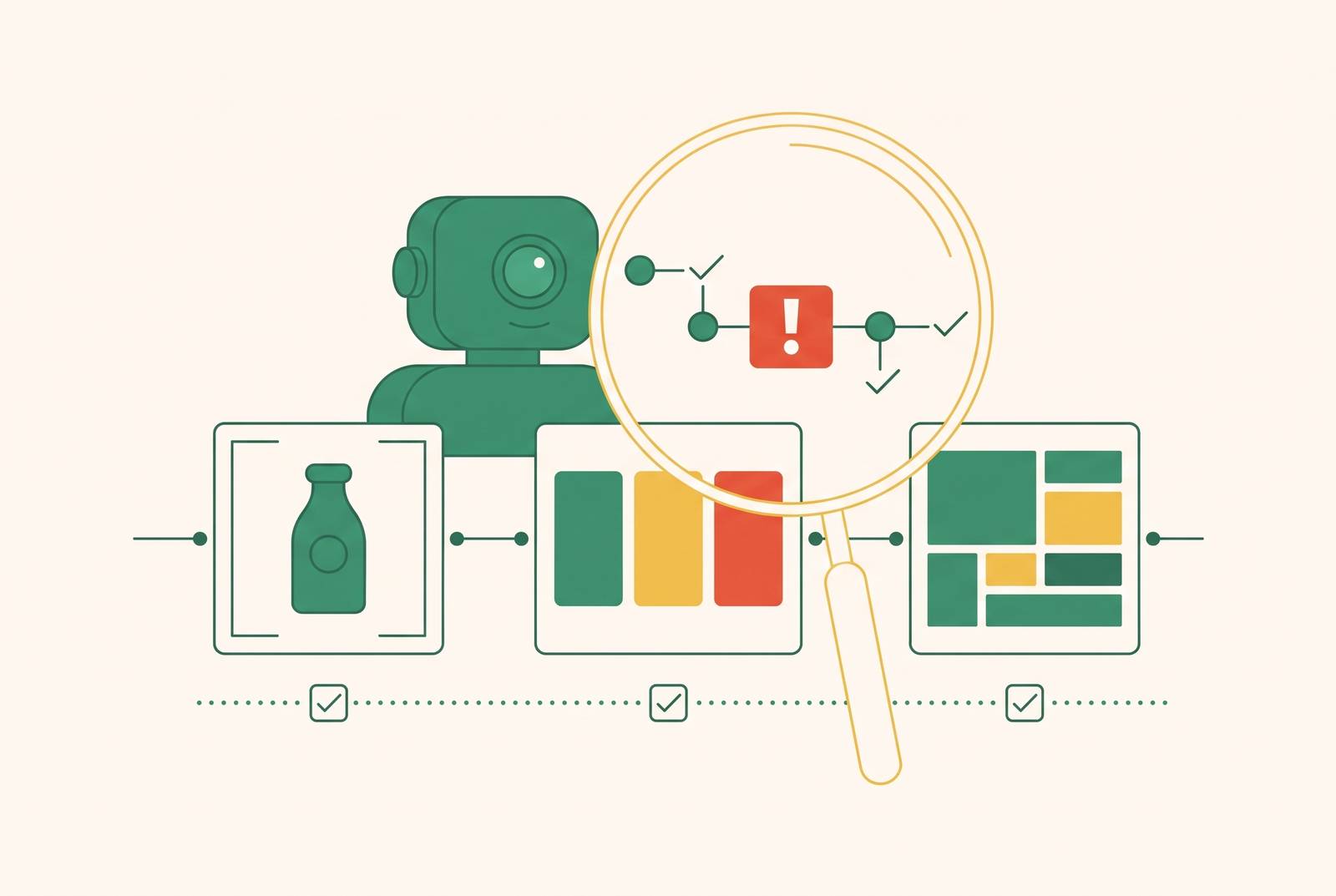
To detect when AI output drifts off-brand, teams must check each asset against specific, versioned brand rules and keep the evidence. Tone drift, incorrect logo placement, and another client’s color token or typeface are signals that review must connect to the relevant rule. AI agent transparency and auditability make that connection traceable, so teams can correct the workflow that produced an error.
Why AI-generated brand creative needs a different kind of accountability
Creative generation now moves faster than the governance built to supervise it. An agent fleet can produce more variants in an hour than a human team produces in a sprint, while manual approvals and spot checks still operate at human pace. Drift can accumulate before reviewers recognize a pattern. The mismatch is structural.
A designer could identify the brief she used, and a copywriter could point to the guidelines behind a headline. A stateless agent producing that headline at 2 a.m. supplies no equivalent memory unless the workflow records its context. Reviewing everything before publication can catch a bad result, but without that record, a reviewer cannot distinguish reliable rule-following from a lucky output. The missing layer is evidence about how the asset was produced.
What "transparency" and "auditability" actually mean in a brand creative context
Transparency makes the evidence for a creative decision visible before or at output. It shows which brand rule the agent applied, which asset it referenced, or which voice parameter it followed. Auditability preserves that evidence for later reconstruction. A brand manager should be able to identify which version of the brand guide governed an asset after the generation session has ended, including after publication.
These properties require different parts of the workflow. An agent can display its references during a session without retaining them, providing transparency but no durable audit trail. Execution logs, on the other hand, can show that an agent ran without showing the brand context it used to make its decisions. The distinction determines whether the repair belongs in what the agent surfaces or what the system retains.
AudAgent research looks at how agents’ runtime behavior across local and third-party services differs from what privacy policies say. It is privacy research. Its relevance is structural, because stated rules and actual behavior are separate forms of evidence. In creative workflows, the brand guide sets out the rules, and generation and review records show whether the output followed them.
How brand context today is structured in ways that make auditability nearly impossible
Static PDFs and undated slide decks give agents text to interpret. A conventional document does not supply a machine-readable field establishing which color palette applied at generation time, or a record that a particular agent consulted it. Moving the document into the cloud does not necessarily fix this. The content may be easier to reach but still hard to trace.
JSON/YAML specifications can express colors, typography hierarchies, voice guidelines, and usage rules as identifiable fields. An agent can reference a field, and a log can retain that reference rather than merely record that a document was available. Without this structure, the output and execution record remain disconnected from the rules that supposedly governed them. A log of activity is not evidence of adherence.
The gap becomes sharper when agencies use a shared generation surface for multiple clients. If neither client’s brand system has identifiable rules, an audit cannot reliably establish which client’s context supplied a creative choice. A review based on judgment may spot a color or typeface that looks unfamiliar. It cannot reconstruct the source of that choice from an execution log that never recorded it.
What structured, versioned brand context looks like and why versioning is the keystone
Structured context gives each rule an identity. Color tokens, typography hierarchies, voice parameters, and logo usage rules become fields that agents can query and cite. Versioning then gives those fields a history, with each change recorded as a discrete, dated snapshot. As with code version control, a team can retrieve the state used at a particular moment.
Stable field names alone are not enough. If a voice parameter changes while its identifier stays the same, an old log pointing to that field does not establish its earlier value. Recording the output, context version, and timestamp creates the foundation for accountability. If guidelines changed in October and an asset was generated in September, the retained version establishes which rules applied when the asset was made.
Model Context Protocol, or MCP, can provide a shared interface through which agents query brand context. Protocol versioning and brand versioning are different, however. MCP requests identify the protocol version being used. The application still has to handle content versioning, and query logging needs infrastructure to support it. With those provisions, a recorded context version makes each later audit reference retrievable and meaningful.
What a meaningful brand audit trail must record at each step of a creative workflow
At brief generation, the record must identify the brand version used to construct the brief. It must also show which voice and visual rules were included, which were excluded, and why. Campaign-specific scope may explain an exclusion. Without that explanation, a later reviewer cannot tell whether a missing requirement was a deliberate boundary or an omission.
At asset generation, the record must identify the model or agent, the active brief, and the brand fields referenced. These may include color tokens, typography rules, and tone parameters, with their version identifiers. These records are needed for copy, image, video, and audio. The record must connect the generated asset to its inputs rather than leave the brief and context as separate, unlinked documents.
At review, the trail must record the rules checked, the output elements examined, and the evidence supporting each finding. A pass/fail label alone is insufficient. The review also needs the version of the brand standard used, so a later audit can compare the requirements used for generation and evaluation. At approval and publication, the record must identify who approved, when approval occurred, and which asset and brand-context versions were current.
AudAgent’s runtime annotation approach offers a structural analogy for recording behavior against a formalized policy during execution. The brand equivalent is evidence captured during the workflow. A useful test is whether a brand manager six months later could reconstruct the governing rules and assess adherence from the record alone. Where research, copy, and image agents contribute to one asset, that record must chain their contributions together.
Why governance design must precede agent deployment, not follow it
Retrofitting auditability starts with an absence that new tooling cannot repair. If no record exists of the context used during an unmonitored period, later logging cannot recover that missing baseline. The outputs remain unattributable to a known brand state. Governance therefore has to define the evidence requirements before agents begin producing assets.
Human-AI handoffs provide the workflow against which those records become legible. They establish which steps require review, which outputs trigger escalation, and which content cannot ship without approval. Constraints on publication and brand claims must be embedded when agents are built, so their application can be recorded during generation. Otherwise, logs show what happened without showing whether someone stepped in when required. The practical minimum is a versioned workflow map for each content type, including social, campaign, and product copy.
Access rules belong in that design as well. Gravitee’s 2026 report states that 45.6% of teams still rely on shared API keys for agent-to-agent authentication. Shared credentials undermine attribution to individual agents, weakening the access history needed for a brand audit. Defining which agents may access which brand assets before connection gives the subsequent access record a standard to measure against.
How detecting when AI output drifts off-brand differs from approval alone
Conventional approval asks whether an asset looks right to a reviewer. Evidence-based review asks whether a specific element satisfies a specific rule from the applicable brand version. Two reviewers may approve or reject the same asset differently, but a documented rule, output element, and finding can be examined after either decision.
Review must check tone drift in copy against the voice parameters for that brand version and logo placement against its logo usage rule. Review must link an incorrect color token or typeface to the brand system of the client the asset was made for. The audit record identifies the rule, the element, the finding, and the brand version. That is more useful than an unexplained overall approval because it identifies what failed.
Consider a campaign template used in more than one market. Independent human approvals produce judgments that may not be comparable, whereas evidence-based review evaluates the variants against the same brand standard. Findings that keep coming up then show which rules need attention in the next brief or update to the context. The review record must link back to the context version used at generation, making any difference between generation and review standards explicit. This closes the loop between detecting drift and correcting its source.
What shared brand context across agents adds to auditability that siloed context cannot
A research agent and brief agent may keep an old voice guide while copy and image agents later in the workflow use the new one. The asset they make can mix two brand states. Without version records for those contributions, the audit cannot establish which rules applied where.
A shared, versioned source gives connected agents an authoritative reference. Each contribution can record the context version it used, making the version boundary visible across the workflow. Agents still need to be connected to a specific version, rather than a floating document whose contents can change without a retained identity.
MCP can serve as the protocol layer for that shared source, with each query treated as an event against the brand resource. External logging, including through OpenTelemetry, can keep a record of those events. The protocol does not itself guarantee the audit trail. The architecture must preserve content versions and record changes with a timestamp and diff, so an update is an auditable act.
For agencies, shared context must also have strict workspace isolation per client. Access to Client A’s brand context must remain distinguishable from access to Client B’s. That separation makes cross-client contamination detectable in the logs if it occurs.
What brand teams and agencies can do now to build audit-ready creative workflows
Restructure colors into tokens with stable identifiers, voice parameters into named fields, and logo and typography rules into structured specifications before connecting agents. Establish versioning as part of that foundation. Every change needs a dated, labeled version, and each agent must use a specific version.
Next, map the workflow for each type of content. Document where AI acts autonomously, where a human must intervene, and what evidence that intervention must produce, then version the map with the brand context. Once those boundaries are set, connect agents to the shared source through MCP or an API. The connection must preserve version identity across the workflow.
Review requirements then become part of the asset’s permanent provenance. Require the rule checked, the output element examined, the finding, and the brand version, rather than treating approval as a gate whose evidence disappears after publication. Agencies must also build client workspace isolation into the infrastructure so the history of access and review for each client stays separate. Auditability separates trustworthy brand workflows from ones that drift silently by making errors traceable to rules, context, and decisions that teams can repair.