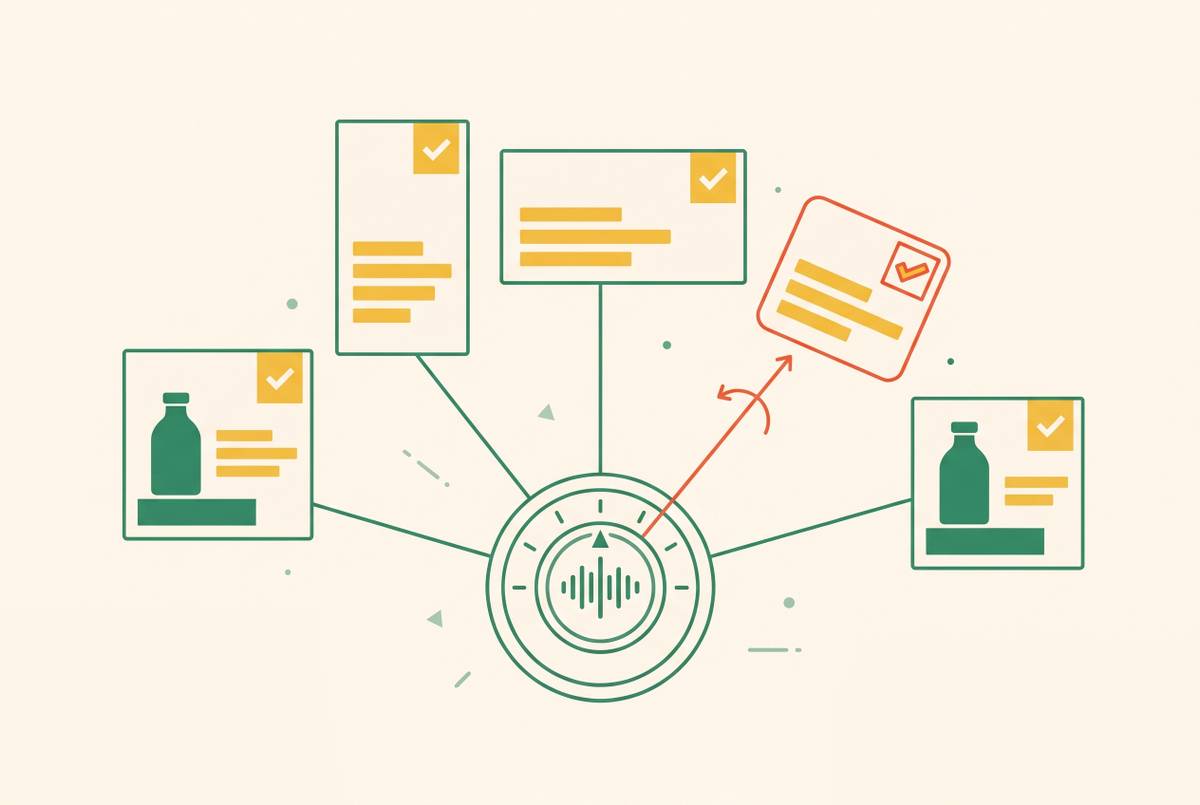
Human Review Gates in High-Volume AI Creative Pipelines
Four human checkpoints keep AI-generated creative on brand at scale.
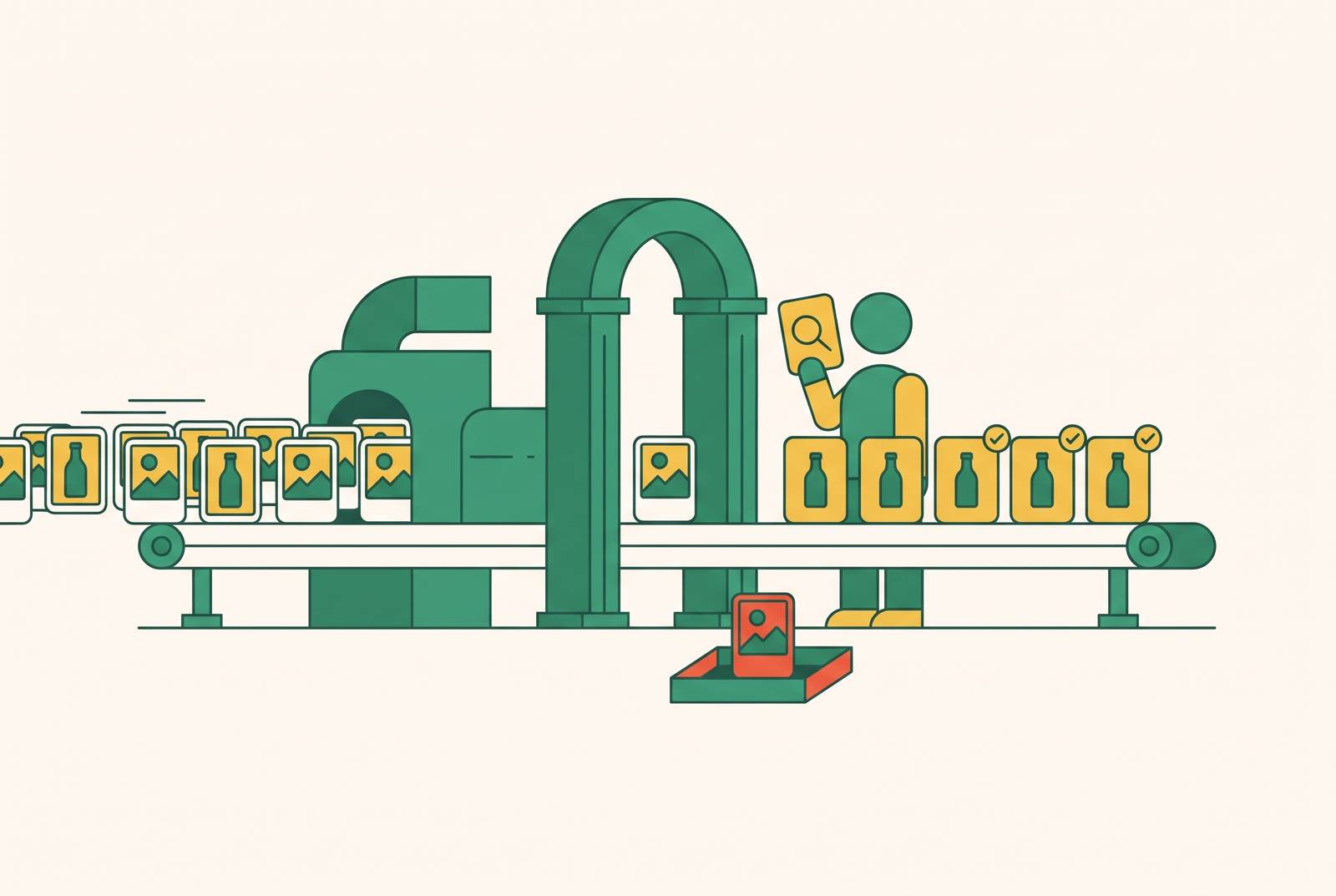
Detecting when AI output drifts off-brand requires comparison with current brand criteria. Human review is most effective at four handoffs, which are brief formation, first-pass direction, pre-launch approval, and post-performance evaluation. Shared, machine-readable brand context makes those decisions enforceable, so a high-volume AI creative pipeline can scale both brand integrity and production.
Why high-volume AI creative pipelines produce consistent volume but inconsistent brand output
Production capacity is no longer the binding constraint in AI creative pipelines. Keeping the work true to the brand is harder. It is easy to generate large numbers of variants, but generating them faster does not improve first-pass quality. A majority of creators report that their AI output needs moderate or extensive editing before it is ready to share. The ability to produce more work therefore expands the amount of work whose brand fit remains unresolved.
Brand drift is the specific failure this creates. Without codified, machine-readable constraints, AI defaults to statistically probable output, smoothing away the characteristics that distinguish one brand from another. The result can be polished without being distinctive. Drift also accumulates across handoffs, as a strategist works from memory, a designer uses a different model, and an agency relies on a template six months stale. Each person's work can look right on its own even as the pieces together drift away from the brand.
The detection signals extend beyond tone of voice. In AI video, predictable failures include brand voice drift, false claims, visual inconsistency across scenes, platform spec violations, and wrong CTAs. These signals expose different gaps in the production process. A wrong CTA asks for the wrong action, while scenes that do not match break visual continuity. Treating both as a general quality problem obscures where the pipeline lost its constraints.
Why treating human review as a final catch-all makes the problem worse at scale
End-of-pipeline review concentrates every unresolved decision at the most expensive point. By then, time and compute have already been spent, making reviewers reluctant to reject work that is merely adequate. In paid media, spend can also be at stake. By the final review, a reviewer must tell a weak concept, an unsupported claim, and an execution error apart when all three are already part of the finished assets. Rejection becomes harder precisely when it needs to remain credible.
A modest weekly asset count may be manageable, but an order-of-magnitude increase does not come with a matching increase in human attention. Review becomes a bottleneck or gets bypassed entirely. Meanwhile, a single unreviewed claim can spread across hundreds of variants, turning a wrong price or unsubstantiated superlative from an isolated mistake into a liability. The single-gate model forces a false choice between throughput and oversight.
Platform algorithms can favor engaging hooks that the brand team never approved, so work can drift after launch despite strong performance metrics. Better upstream brand infrastructure reduces the number of failures, but it does not eliminate judgment about creative direction, claims, or spend. Human judgment therefore needs authority before a wrong decision propagates.
What makes a checkpoint a gate rather than a suggestion
A gate is a human decision with a named owner, written pass criteria, and three possible outcomes, namely pass, revise, or stop. Its authority comes from those conditions. When the criteria are not written down, reviewers judge work by their own taste. Without a way to stop it, work that should go no further keeps coming back for more revisions. A five-phase workflow with four fixed gates provides the scaffolding, while each gate defines a distinct decision.
Review compares work with the approved brief, current voice and visual rules, substantiated claims, platform requirements, and authorized creative direction at the relevant handoff. Risk determines who must approve the result. Internal assets need one review, standard campaign assets need creative and brand review, and high-risk work needs creative, brand, legal, and stakeholder sign-off. That last category includes product claims, use of a person's likeness, and entry into a regulated market.
QA agents can flag token misuse, contrast failures, banned terms, and platform spec violations before human review. This leaves strategic judgment to the named owner. In paid media, generation and tagging are easier to automate almost fully than steps that involve spend, claims, or brand safety. A successful automated check therefore does not, by itself, authorize the work to proceed.
Where the four gates belong and what each one is scoped to evaluate
The first gate is brief approval, before generation begins. It protects the handoff from research and problem definition into production, where an error can replicate into every downstream asset. AI can summarize research and draft constraints, but humans approve the problem, audience, success measure, and brand parameters. The reviewer is judging the assignment. If the brief defines the wrong problem, better variants will not repair it.
In paid media, this includes creative concept approval before anything enters the ad account, because offer framing and pricing claims are set here. The machine's brand references also need approval at this point. Locked references, voice parameters, and do-not-use lists should be current before generation starts. When a brief uses an old voice rule, everyone who works from it later has the wrong standard. This makes brief approval a check on both strategic intent and the validity of the inputs.
The second gate is direction approval in the Explore phase, after first-pass output and before the full build. AI makes variations, and humans choose the creative path that fits the strategy and brand. The unit of review is the direction. Comparing a handful of directions is a different cognitive task from inspecting hundreds of finished variants, and it keeps the decision within what a reviewer can evaluate at speed. Execution polish is not the question yet.
This scope also makes drift cheaper to catch. A generic voice or off-brand visual approach can be rejected before it becomes the basis for the full set of variants. The reviewer is not choosing the best isolated asset. The decision establishes which direction is suitable for further production, so an attractive execution cannot compensate for a concept that does not fit the brand.
The third gate is pre-launch compliance, after the build and before spend starts. Its scope is claims, safety, and spend authority. A delayed launch costs time, while a wrong price or unsubstantiated claim distributed across hundreds of variants creates exposure that cannot simply be recalled. For AI video, assets should stay blocked until the sign-off is logged.
The checks here include script review against substantiation files, visual consistency, and platform specifications. AI-disclosure metadata must also be attached before spend starts. These are release conditions. Keeping that line clear stops compliance review from reopening creative questions settled during Explore. It also preserves attention for the errors that make an otherwise approved campaign unsafe to launch.
The fourth gate is post-performance review, after data accumulates. It protects the handoff from observed results into further optimization and budget decisions. Strong engagement is not proof of brand fidelity. The reviewer checks whether the variants being surfaced still fit the direction approved at the second gate. Human sign-off before scaling spend on early winners prevents a successful but off-brand hook from gaining reach through a loop that cannot correct that judgment itself.
Why gates fail when brand context is not machine-readable upstream
A gate cannot reliably enforce a standard the pipeline never received. A PDF brand book read by a human during brief approval is not equivalent to machine-readable context available to every agent. Traditional guidelines often leave gaps for a designer to fill with their own judgment. For models, those gaps need to be filled with tokens, templates, reference images, or locked styles. If those gaps stay open upstream, reviewers have to keep fixing the ways the system reads the rules.
Julia Jaskólska, Brand Design Lead at Zapier, articulated this dual-audience requirement by describing brand guidelines as serving both humans and machines. Addressing only one leaves the other without usable guidance. For visual work, that means going beyond hex codes to defined composition ratios, depth-of-field parameters, and lighting models. Approved images and composition examples show what those standards look like. Rejected examples labeled with the reason make the boundary clearer for both reviewers and models.
Versioning is equally important to the review standard. A precise constraint can still be wrong if it belongs to an outdated version of the brand. When context is versioned and current, brief approval becomes a check that the right version has been used rather than an exercise in reconstructing rules from memory. Reviewers who check the work later then use the same reference. Without that shared reference, work can pass the checks at each stage while the campaign as a whole still fails to fit together.
How do MCP and a shared brand layer prevent AI agents from drifting off-brand?
The Model Context Protocol, or MCP, provides a shared way for agents to access systems that expose brand context. Its role is infrastructure. By mid-2026, support spans ChatGPT, Claude, Cursor, Windsurf, VS Code, Gemini CLI, and most major IDE assistants. For multi-brand agencies and enterprises, a shared protocol reduces the need for custom logic at every agent handoff across systems such as a CRM, a CDP, a payment platform, and a consent management tool.
Frontify provides a concrete example through its native MCP server. It exposes brand assets, guidelines, tone-of-voice rules, style guides, templates, creative generation from templates, and copyright and license information. Brand context becomes something an agent can query. When that shared context is also versioned and current, different agents can work from the same approved constraints.
That changes the emphasis of human review without removing it. Reviewers spend less time checking whether the AI understood basic brand rules and more time judging whether the direction and claims say what the brand wants to say. Governance still needs explicit attention at release. The MCP roadmap flags that authorization assumes a person with a browser at consent time, while callers increasingly include agents acting for absent users. That unresolved distinction is relevant to audit trails at the pre-launch gate, where authority to proceed must remain clear.
What the pipeline looks like when gate placement and brand infrastructure work together
AI handles exploration, ideation, early drafts, variation, and distribution, while human expertise leads strategy, creative direction, polish, and final execution. Gates enforce that division of labor. AI first drafts produced in minutes can yield net time savings of 50–70% over writing from scratch when humans review and edit.
For an agency managing multiple brands, the structure stays consistent while the criteria change by brand. Shared infrastructure maintains those criteria centrally instead of requiring their reconstruction for each client engagement. Reviewers can then spend attention on the decision before them. Early intervention prevents expensive rework, while release and performance decisions prevent consequential errors from reaching or expanding in the market. As the system matures, fewer routine corrections compete with judgments that require human authority.
The operational test is whether removing a gate would increase brand drift or compliance risk. A structural gate protects a decision that cannot safely be delegated to production speed or platform performance. A checkpoint that protects neither is overhead. With current criteria available upstream and clear authority at vulnerable handoffs, the pipeline can reject an unsuitable direction early and refuse to scale an off-brand winner later. Its success is not measured by how much humans review, but by whether their decisions control what advances.