Your DTC AI Stack Sounds Inconsistent Because Each Tool Is Running a Different Version of Your Brand
Shared, persistent brand context is what keeps AI tools on-brand.

A DTC AI stack sounds inconsistent when each tool generates from a different version of the brand. Preventing that drift requires shared, persistent brand context. Detecting when AI output drifts off-brand requires checking finished work against explicit voice, messaging, and visual rules, with evidence for each check before publication.
Why DTC brands are running five different brand voices at once
A customer receives a clinical email, encounters a hype-heavy ad, and lands on a neutral product description. A conversational UGC clip and a formal blog post add two more impressions of the same company. Each asset may be competent on its own. Together, however, they offer conflicting signals about how the brand speaks, what it promises, and whom it serves. The customer encounters what amounts to five different companies across five touchpoints.
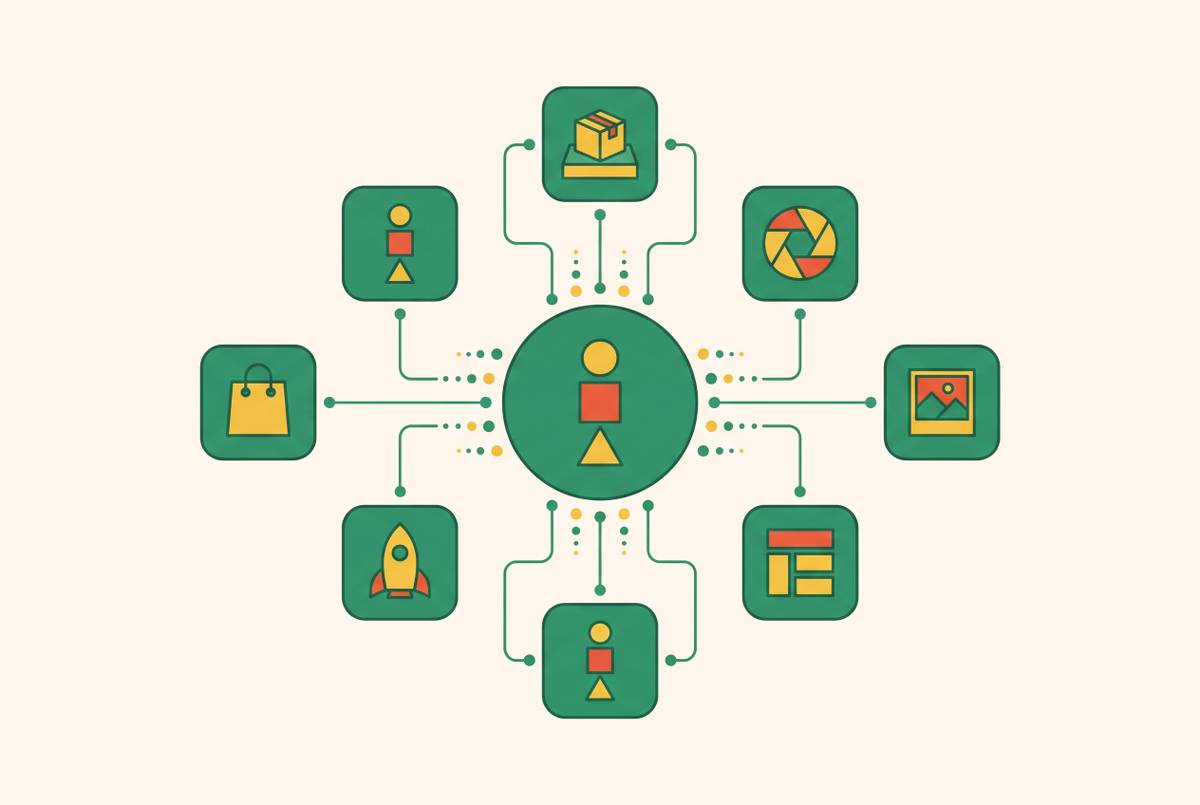
When email, advertising, product copy, video, and blog tools operate without shared brand context, each starts from its own zero-state. None knows what the others have generated, and each depends on whatever brand information reaches that session. This architecture problem allows a capable tool to produce polished work while drawing on an incomplete or contradictory account of the brand.
Different channels do not need identical language. A product description and a UGC script have different jobs, so their delivery can reasonably differ. Those differences become a problem when they change the brand’s positioning, claims, or underlying voice. Without a common reference, the stack cannot reliably distinguish useful adaptation from drift.
How the DTC stack got siloed in the first place
DTC teams assembled their stacks around specific production needs. Klaviyo earned its place in ecommerce email through deep Shopify data integration and useful predictive analytics. Flair met the need for lifestyle creative that was ready to use in social and email. Creatify offered ad-ready UGC-style video without the cost and time of a conventional production process. Each choice made sense within its category.
But the tools each developed their own way of handling brand information. Catalog data can give an email tool product names and prices without giving it the brand’s voice, customer objections, or competitive positioning. Photography tools can approximate a color system without enforcing it, while a video tool can generate from a brief without retaining that context for the next session. Product knowledge is not complete brand knowledge. The information that makes a tool useful for its category does not necessarily tell it how to represent the company.
Teams bought specialists to solve different problems, and those tools were not built around one persistent brand source. No single platform handles every output well enough to remove the need for specialization. A coordinated stack is therefore needed for 2026. Coordination has to supply the shared context that category-by-category adoption left out.
What fragmentation actually costs a DTC brand now that AI drives discovery
AI-powered shopping makes brand coherence a discoverability input. Assistants recommend and rank brands using the coherence and specificity of the signals they encounter across sources. Consistent, repeated positioning gives them a clear account of what a brand offers and which use cases it serves. Contradictory positioning gives them a less dependable account.
Criteo’s analysis identifies relevance as what opens the door to discovery, even while budget remains important. Precise, use-case-specific product data can help a brand surface ahead of a competitor spending far more. That changes the competitive role of consistency. A brand needs more than a recognizable tone across channels because its product information and positioning also need to reinforce the same specific reasons to choose it.
The commercial consequence follows from that discovery mechanism. A brand that surfaces inconsistently has fewer dependable opportunities to enter an AI-assisted buying journey. More output does not resolve the problem if the additional assets repeat conflicting descriptions of the company. As AI-assisted discovery grows, the distinction between coherent and fragmented brand signals becomes increasingly consequential. Consistency is no longer solely an editorial preference applied after production; it is part of the information that makes the brand discoverable.
Why better prompts into each tool do not solve the problem
Careful prompting improves an individual generation session. It can supply tone, approved product claims, model choices, visual style, CTAs, and words to avoid that a generic tool would otherwise lack. The limitation is where that knowledge resides. When it exists only in a prompt, whoever runs the next session must reconstruct it.
Rebuilding that knowledge by hand gets harder as teams make more content. Meta Advantage+ and Google Performance Max recommend many creative variants for each campaign, so teams must weigh how much they need to make against the time it takes to brief every tool. Different operators also bring different interpretations of the guidelines. Five tools run by three people can therefore produce up to fifteen versions of the brand. The variation comes from both the tools and their inputs.
Without a locked brand model library, photography tools get close to the brand’s colors, packaging details, and overall visual style but cannot enforce them. The assets in a twelve-asset campaign can look like they come from twelve different worlds. Trained faces, locked lighting seeds, and enforced color grades address a structural problem that descriptive prompting alone does not.
Pasting a 60-page brand guide into every session still means someone has to add the context by hand. The document remains a human reference. Careful instructions need a persistent home that does not depend on who opened which tool.
What shared brand context actually looks like in a machine-readable form
A machine-readable brand context layer contains explicit, labeled rules that tools can retrieve and apply. Voice exemplars, color values with usage constraints, typography hierarchies, messaging guardrails, approved proof points, and words to avoid belong in that structure. The labels distinguish what each rule governs. Instead of asking an agent to interpret an entire document afresh, the structure makes the relevant guidance available for the task.
For copy, the foundation includes a brand voice document with concrete examples, the full ideal customer profile, the strategic narrative, a customer language library, and approved proof points. These inputs serve different purposes. Voice examples show how the brand speaks, while customer language and the ideal customer profile show who it speaks to. The narrative and proof points define what it can credibly say. Omitting that foundation makes rapid production possible at the expense of sustained quality.
For visual output, the equivalent foundation is a brand model library. It has trained fictional faces as LoRA fine-tunes, locked lighting seeds, and enforced color grades. These controls make campaign consistency across twelve or more assets repeatable across sessions. Visual identity becomes a production constraint.
Persistence is the operational distinction from a static guide. Traditional guidelines are updated infrequently and applied manually by people. A shared context layer lets production start from the brand knowledge already established, rather than rebuilding that knowledge every time content is needed.
How MCP lets every agent in the stack draw from the same brand source
MCP gives compatible agents a live connection to a canonical brand source. An MCP server can expose voice rules, visual identity, positioning, and specific dos and don’ts for an agent to query before generation. That changes the basis of the brief. The agent can consult the brand’s actual information instead of relying on general training knowledge or a manually pasted fragment.
For a marketer or founder, the practical benefit is access to the right material within the workflow. An agent can check a style guide, reference past campaigns, or draw from an approved asset library before producing content. Notion’s official developer documentation describes a hosted MCP server that lets AI clients search, read, and write content in a workspace. Google’s official developer documentation describes a remote Drive MCP server that has tools for file-search and file-reading. With those connections, agents can get the documents without someone having to rebuild context by hand between tabs.
An agent can consequently retrieve an ideal customer profile, brand voice profile, and content calendar by name within a session. The connection does not replace the work of defining those materials. The connection also needs compatible specialist tools. Its role is to make the established brand source accessible to compatible agents.
Anthropic open-sourced MCP in late 2024. For a multi-tool DTC operation, its relevance is the separation between specialization and context. Tools can keep doing what they do best while connected workflows draw on the same brand information.
What a DTC brand stack looks like when every tool draws from one brand context
In a connected stack, email and lifecycle production still use the capabilities that justified the email platform. Klaviyo retains the value of its Shopify integration and predictive analytics. In a workflow connected to shared context, however, the voice governing subject lines and copy comes from the common brand source rather than a generic instruction or isolated snippet. Product data and brand guidance serve complementary roles. One describes the offer. The other governs how the company presents it.
Photography follows the same division of responsibility. Flair can produce lifestyle creative for social and email, while the central brand model library supplies the controlled visual foundation. The library lives in one place across campaigns. Email imagery and advertising creative can therefore draw from the same established faces, lighting, and color treatment, even when their formats differ.
UGC production adds a distinction between consistency and meaningful experimentation. Creatify and similar tools can make ad-ready video fast, but changing the face while keeping the same script changes only the surface and does little to test the creative. Shared context sets out what must stay the same in scripts and visual treatments. Those rules leave room to change the creative while keeping the brand itself the same.
The economics depend on that discipline. A 200-SKU brand’s AI-led production stack can cost a fraction of a traditional studio stack annually. Those savings only hold if the brand stays consistent as teams make more content. Lower production costs do not justify a system that multiplies conflicting versions of the company.
Reviewing AI output against the brand before it ships
Detecting when AI output drifts off-brand means comparing the finished asset with explicit brand rules. Detection signals include departures from approved voice exemplars, prohibited words, claims outside approved proof points, and contradictions in positioning. Visual signals include the wrong use of the logo, typography, colors, and imagery. These are distinct checks, and an asset can meet one rule and fail another.
Each check needs to identify the relevant rule and the evidence in the finished work that supports the assessment. For voice, the reference is the approved guidance and its concrete exemplars. For visual identity, the references are the defined usage rules and constraints.
Shared context reduces drift but does not remove this verification step. A team generating thousands of assets a month cannot manually inspect every item as it could when throughput was fifty assets a month. Review therefore needs the same structured foundation as generation. Agencies and multi-brand operators also need to apply each brand’s own rules without mixing up one brand’s standards with another’s.
The operational outcome is production and review grounded in the same source. Specialist tools generate at AI speed, compatible connections supply persistent brand context, and evidence-based checks assess the work before it reaches customers. Across email, advertising, product copy, and video, the brand sounds like one company at scale.