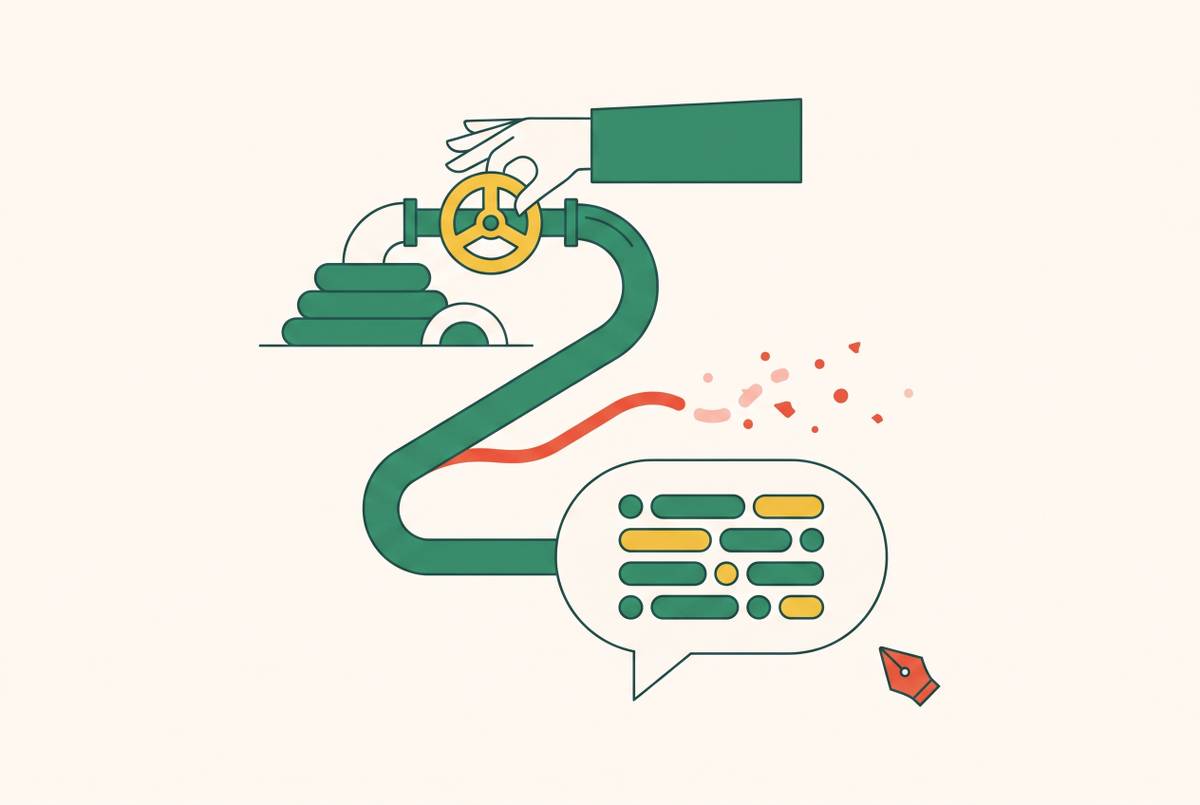
Wiring a Single Brand Context Into Every Node of a DTC AI Creative Workflow
Keeping AI agents aligned requires centralizing brand rules so every node queries the same source.
Detecting when AI output drifts off-brand requires checking it against explicit brand rules and producing evidence of which rule was checked, what the output showed, and whether it passed. To prevent that drift, every production and review agent must query the same versioned brand context. Wiring that context into a DTC AI creative workflow makes consistency a property of the system.
Why DTC creative workflows drift even when every individual agent performs well
DTC brands run AI agents across copy, email, ad creative, and image generation simultaneously, producing content for multiple channels. Each specialist may do its own task well. Yet each receives its own prompt, partial briefing, and version of what the brand sounds and looks like. When those inputs differ, better execution can just make each agent’s different take on the brand look more polished.
The failure begins with that architectural isolation. A copy agent works from last month’s tone guide, an image agent receives a logo from a Slack upload, and an email agent follows a brief the founder wrote ad hoc. Prompt-only context gives each agent its own approximation of the brand. Those approximations diverge even when no individual output looks obviously wrong.
Agentic brand drift accumulates through these inconsistencies without a single triggering event. Voice gradually regresses toward the generic model mean, while colors shift and visual treatments wander. This differs from deliberate brand change or an isolated mistake. Performance metrics can improve as the brand becomes less distinct, so the usual monitoring can miss the change.
What the volume of modern DTC creative output makes structurally necessary
A high-performing consumer brand produces ad creative across Meta, Google, TikTok, LinkedIn, and its website. That breadth creates repeated opportunities for stretched logos, shifted palettes, random typography, and off-tone copy when the underlying guidance is fragmented. Manual governance must then keep pace not just with production, but with the variations created across it.
For a DTC brand competing in 2026, the production requirement is roughly 20–30 social posts per week, 8–15 email campaigns per month, and 4–8 SEO articles per month. Most founder-led teams cannot make that much content by hand. AI marketing agents make it achievable without hiring, but their speed shifts the bottleneck from production to brand governance. A process that depends on someone re-injecting context into every task cannot expand at the same rate.
The founder-led version of this problem is especially revealing. The founder uses AI effectively because the brand context is already in their head. The team lacks that implicit briefing, so results vary even with the same tools. AI exposes the existing documentation gap. The structural mismatch is between repeatable production and brand knowledge that remains personal, scattered, and difficult to reproduce.
What it means to structure brand identity for machine consumption
Before agents can share brand context, that context must exist in a form they can parse, verify, and apply. This translates the existing brand identity into machine-readable form. Human-facing guides communicate through design, tone, and storytelling, while machine-readable identity depends on structured data, explicit rules, and consistent facts. A phrase such as “bold, confident voice” leaves room for incompatible readings. A specific constraint gives the agent a defined condition to follow and the reviewer something concrete to check.
That translation has two interdependent layers. The identity layer contains logos, colors, type, and shapes, while the narrative layer contains system prompts, tone-of-voice rules, and the lexicon governing copy. Both guide the choices made during the work as well as how a finished asset looks. In this sense, an agentic brand resembles an operating system more than a style guide. Its context is a resource queried during work.
Machine-readability also has an external-facing complement in schema markup. Organization schema written in JSON-LD declares the brand’s canonical name, logo, description, and social profiles for AI systems, including shopping agents participating in DTC purchase journeys. Within the workflow, each agent needs to be able to get the same clearly stated creative facts.
How MCP gives every node in the workflow access to the same live brand context
Model Context Protocol (MCP) is an open-source standard connecting AI applications to external systems. Its official documentation describes it as “a USB-C port for AI applications”. The protocol provides a shared way for AI clients to connect to data sources and workflows without separate integration code for every vendor. The connection replaces an isolated briefing with access to an external resource.
For brand workflows, that resource is the structured brand context. An agent can query the style guide, approved assets, previous campaigns, and voice rules before generating content rather than relying on general knowledge and a pasted brief. Amazon Ads’ launch of an MCP server in open beta brings the protocol into an advertising setting that DTC marketers know. Its relevance here is the connection model.
That distinction keeps the architecture precise. MCP gives agents access to the source, which holds the brand rules. Access also has a token cost, so agents should load only the context needed for the task at every call. Scoped retrieval keeps a copy task focused on voice constraints and an image task focused on the relevant visual standards.
What the shared-context architecture looks like across each node of a DTC creative workflow
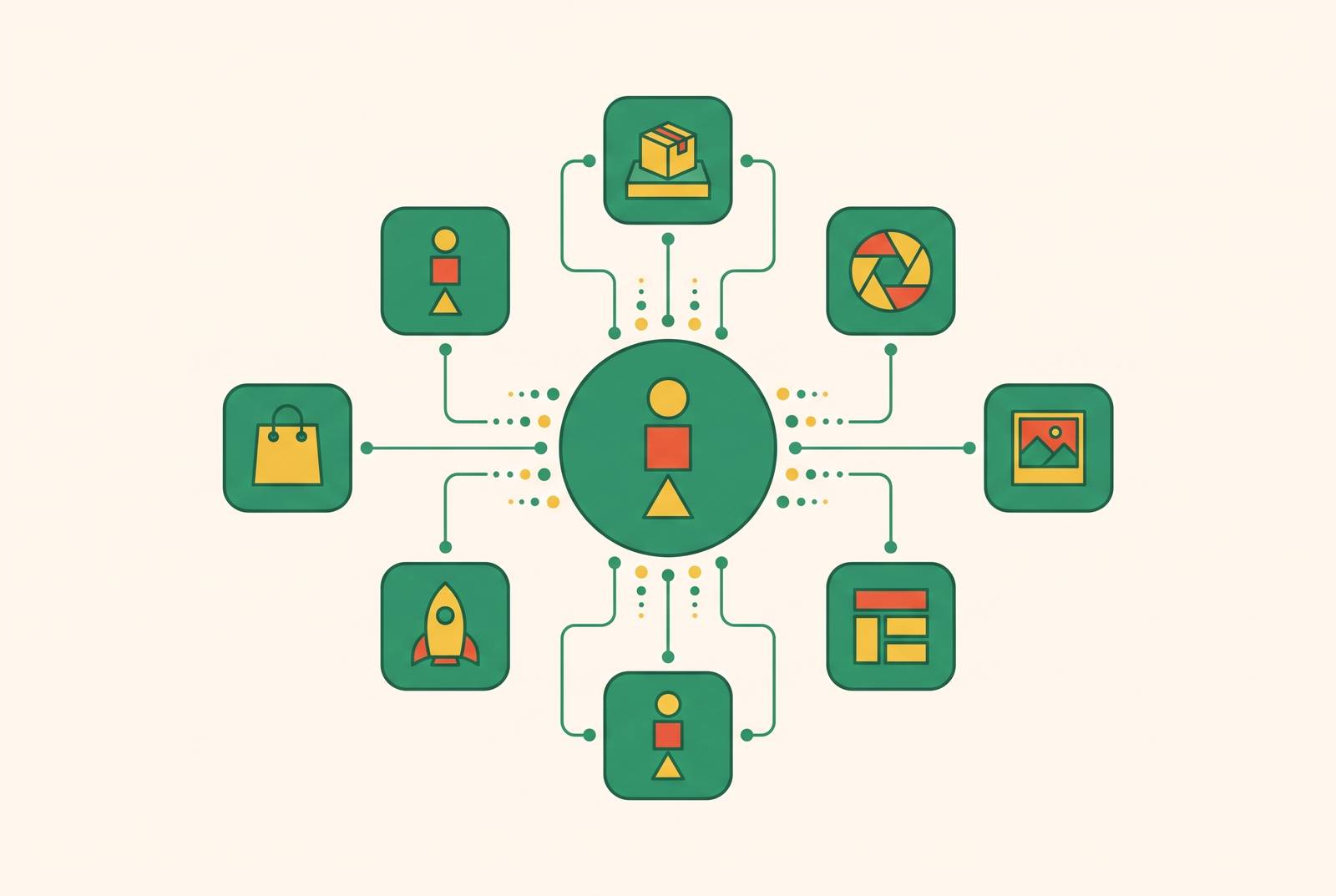
A shared source does not require a single agent to do everything. In the recommended setup, an orchestrator agent keeps the shared brand context brief up to date, and downstream specialists pull the parts they need. Specialization remains intact, and agents can work in parallel. Scoping also limits context bleed, where information unrelated to a deliverable overwhelms the task. The shared reference removes conflicting briefings without flattening the workflow.
For the copy agent, the source supplies tone rules, lexicon, and voice constraints instead of a re-pasted summary. For the image agent, it supplies logo rules, the color palette, and visual style, with approved assets and references persisting across jobs. The email agent draws segment-appropriate messaging rules and design specifications from the same context. The ad creative agent draws the campaign’s logo treatment, type, colors, imagery rules, and voice constraints.
The operational payoff is update propagation. A new color system or campaign-specific rule is updated centrally in the shared context for every specialist. That is a first-party claim rather than independently corroborated evidence, but it illustrates the intended mechanism.
How brand context versioning keeps the shared source current as the brand evolves
A shared reference becomes a liability if it goes stale. Brand context therefore needs the discipline of a codebase, with versioned changes and a preserved history of what changed. A visual refresh, new product line, or campaign voice adjustment changes the rules agents need to use. Uploading a guide once does not meet that requirement. Without a maintained source, the architecture can reproduce the stale-brief problem in a central location.
The practical model is a versioned source that connected agents query as they work. When the brand changes, each agent receives the new version the next time it queries that source. Agents that connect through MCP and products that embed context through an API should use the same reference. Otherwise, each way of connecting can lead to a different definition of the brand.
For multi-brand operations, each brand has its own versioned context and agents configured for it. Keeping brand updates separate preserves the authority of each source while allowing the workflow pattern to be reused. With versioning, update propagation helps the system keep up with brand changes over time without someone having to brief the agents again.
What detecting when AI output drifts off-brand actually requires
Shared context reduces the probability of off-brand output, but it does not eliminate it. Review completes the architecture rather than replacing its inputs. The same agents producing copy, images, and email can review their work against the brand, provided they use the same locked source that informed production. A separate review checklist risks isolating review from the context used in production. End-of-run spot audits are also too slow and expensive for DTC volume.
Detection needs named criteria and evidence for each check. For copy, those criteria come from the tone rules, lexicon, and voice constraints. For visual output, they come from logo treatment, color palette, type, and imagery rules. Email review also checks that messaging fits the segment and follows the design specifications, while ad review checks the campaign constraints that apply.
A useful finding identifies the rule checked, what the output showed, and whether it passed. A bare pass/fail flag is insufficient. Evidence allows the team to act on the finding rather than repeat the review by hand, and makes gradual drift more legible than a general judgment that something feels off-brand. The Stensul MarTech Governance Outlook reports that almost half of organizations say AI has increased compliance or brand risk. The architectural response is review grounded in the production source.
Why wiring brand context in as infrastructure changes what agencies and multi-brand teams can do
Agencies face the same problem with each of their clients, agents, and channels. Each client has its own tone, visual identity, and workflow, while context may be scattered across documents, emails, and account managers’ heads. Every new campaign then creates another interpretation task. More output increases the burden on the people who remember what each brand means.
Each brand retains its own versioned reference, while the agent workflow can be adapted from one account to the next without rebuilding the architecture. An update propagates to agents working on that brand without changing another client’s work. This is multi-brand workflow management at the infrastructure level, rather than a single-brand process repeated through manual briefing.
Reusing the structure still requires documentation, explicit constraints, version ownership, and evidence-based review for every brand. Shared infrastructure makes that discipline repeatable instead of leaving it dependent on individual account knowledge. Agencies are therefore the stress test of the model. If the architecture preserves distinct identities across dozens of brands, it demonstrates that shared workflows need not produce interchangeable creative.
The practical sequence for wiring shared brand context into an existing DTC workflow
Before connecting any agents, a team should collect voice guidelines, visual standards, logo files, color systems, and audience definitions into one queryable location. Each guideline then needs translation into a constraint an agent can apply without guessing. Public-facing schema markup extends the machine-readable identity into AI-driven discovery.
Next, the team should connect its highest-volume, most repeatable workflow node. Email briefs, social copy, and product descriptions are candidates where the work follows a consistent pattern. One workflow should run all the way through with context loaded, the output format locked, and the team trained. It should complete a cycle before another node is added. This keeps the transition grounded in a working production process.
Before adding more nodes, the team should decide who owns context updates and what calls for a version change. Campaign launches, visual refreshes, and voice evolution all need a place in that discipline. Every connected agent should use the updated version automatically, without someone having to brief it again. Scaling should follow that confirmation.
Finally, output review should use the same source as production. Each check should name the brand rule it tested and give a finding backed by what the output showed. This closes the loop between the instructions agents receive and the work they return.