Brand Voice Injection Through Workflow Infrastructure Instead of Prompt Text
Shared brand context in the workflow keeps every agent on-voice.

Detecting when AI output drifts off-brand requires checking tone, vocabulary, sentence structure, visual identity, and positioning against a shared brand reference. To prevent that drift across agents, teams need to move brand voice out of repeated prompt text and into workflow infrastructure. That infrastructure gives every agent the same context, while evidence-based review checks whether the work they produce expresses the brand.
Why brand voice breaks down when more than one agent touches a campaign
“Style creep” is the tonal and visual drift that develops when different prompts, sessions, and contributors pull campaign assets out of alignment. Its warning signs include inconsistent vocabulary, changes in sentence structure, stretched logos, fuzzy palettes, and random typography. Each asset may look acceptable in isolation. Across a campaign, however, those differences weaken the sense that one brand is speaking.
The dominant prompt-based workflow makes that relationship difficult to govern. A contributor pastes a style guide into a chat window, explains the tone, and works within that session. Another contributor repeats the process elsewhere, often with an abbreviated or paraphrased version. Both may be skilled at directing an agent. They are nevertheless working from separate inputs, without a shared constraint that persists across the campaign.
Model changes introduce another source of variation. OpenAI, Anthropic, and Google push updates that can shift how an unchanged prompt is interpreted. Meanwhile, a high-performing consumer brand produces a large volume of ad creatives across Meta, Google, TikTok, LinkedIn, and its own site. At that volume, relying on per-session discipline to govern consistency across every handoff is a structural weakness.
Why prompt text is the wrong layer to solve a structural problem
Prompt text applies to one act of generation. It tells an agent what to produce, which language to favor, and what to avoid. It does not, by itself, establish the conditions under which every agent in a workflow operates.
Even a system prompt encoding brand guidelines is still an instruction interpreted during a task. Strong optimization signals, including performance, task completion, and user feedback, can compete with it. Architectural constraints operate at a different level. They determine which brand context the workflow supplies and whether agents share that context, rather than leaving those choices to whoever initiates a session. Override resistance therefore has to come from the workflow’s structure.
Fragmentation makes the limitation practical as well as architectural. When contributors re-enter the same guidance in different forms, the supposed common prompt is no longer one document. Brand voice becomes dependent on the most recent or emphatic instruction. Prompt craft still helps make a task clear. It cannot serve as the governing layer for a system whose participants each hold a different version of the brand.
What "moving brand voice upstream" actually means in practice
Moving brand voice upstream means keeping it as structured, machine-readable context that every agent queries before it produces work. The practical artifact is a set of persistent reference files. Those files set out the voice profile: its tone, vocabulary, sentence structure, and things the brand says and never says. They also contain positioning and visual identity tokens covering color, type, and logo rules. Every session inherits these inputs automatically.
A human-readable brand book is not sufficient as-is. People can interpret a color guideline, infer a pattern from screenshots, or fill gaps with shared knowledge. Agents need those expectations made explicit. Design tokens take the place of informal color guidance, component libraries give agents a reference to work from in place of screenshots, and structured content models take the place of unstructured Word documents. Rules that previously depended on tribal knowledge become available to the workflow itself.
This changes the relationship between identity and production. The brand becomes a persistent input that the system draws from. The team’s work therefore moves from repeated explanation to maintaining an authoritative reference. That reference must stay up to date, because automatic access only helps when the description still fits the brand.
How MCP delivers shared brand context to every connected agent
Model Context Protocol (MCP) provides a shared way for AI agents to connect securely to external tools, databases, and APIs. It is an open standard with a single interface for those connections. For brand teams, its value is direct. An agent connected to brand context can query the voice profile, look at past campaigns, and use approved asset libraries before it produces work. Generation is grounded in actual brand data rather than general knowledge and a contributor’s recollection.
The “USB-C” analogy describes this role usefully. A team builds a brand context server once, and connected writing assistants, design tools, and campaign schedulers can draw from the same source. The protocol gives products a shared connection, so teams no longer have to keep a separate description up to date by hand for each product. In a workflow configured to query that source automatically, access to brand context becomes part of production. It is not a separate act of prompt preparation.
Delivery, however, is not the same as judgment. MCP makes authoritative content available to the model, but it cannot make poor source material accurate or complete. Stale, incomplete, or fragmented brand data becomes reliably wrong at scale. One source of truth improves consistency only when the team keeps that source fit to govern the work.
What a brand context layer looks like across a multi-agent content pipeline
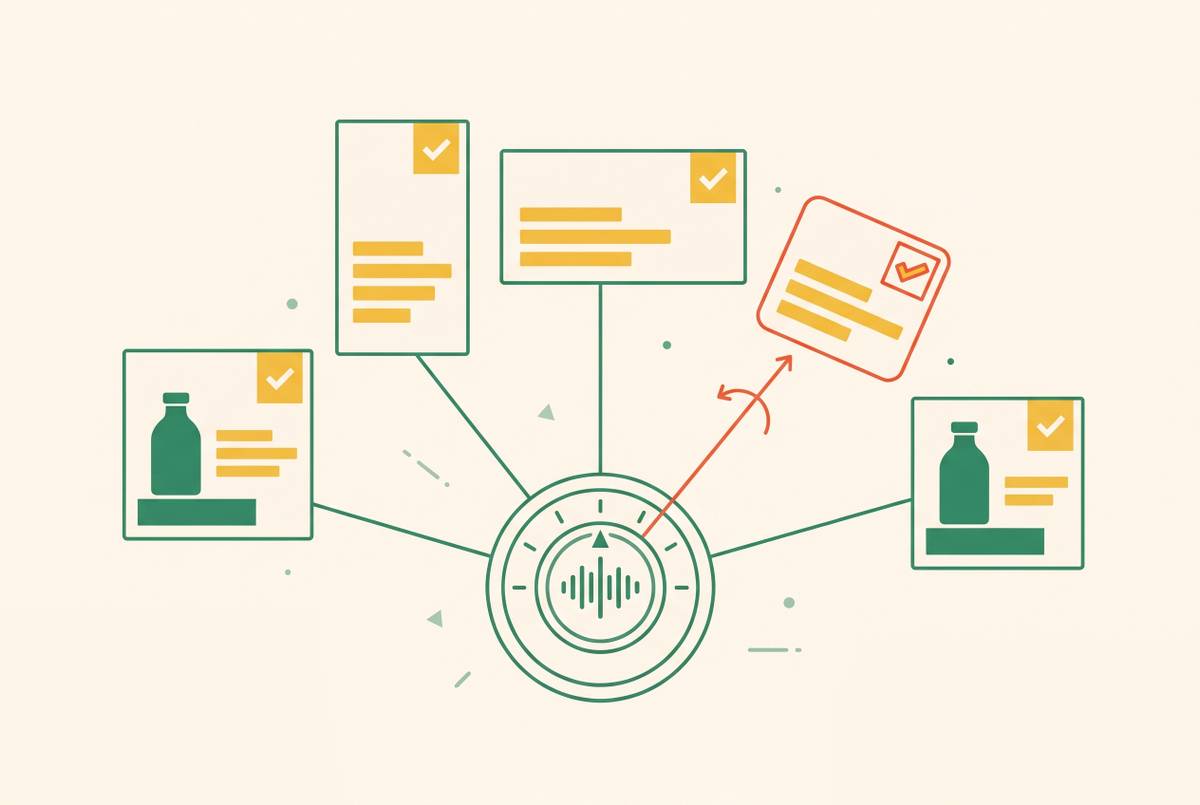
A copywriting agent drafts, a brand-integration agent checks voice and visual alignment, an editor refines tone and fixes inconsistencies, and a fact-checker validates claims. Each does a different job using the same brand reference. The editor does not need to reconstruct the copywriter’s interpretation from the draft. The fact-checker also has access to the positioning that frames the claims under review.
Without unified coordination, modules process their inputs in isolation and discard metadata needed downstream. A design agent may not have the voice rules the copy agent used, so each handoff gives the work another chance to drift. Shared context preserves a common referent across those roles. A promotional email, campaign landing page, or launch deck can also involve agents working in parallel and merging their artifacts. Their tasks differ, but their brand constraints do not.
The visual layer follows the same principle. Automatically supplied color, type, and logo tokens constrain generated assets rather than leaving appearance to independent interpretation. Versioning keeps that shared reference in step with changes to the brand. After a repositioning, visual refresh, or new voice direction, every connected agent should use the updated context. For a multi-client workflow, the same requirement applies within each client’s separate brand environment.
Why agencies and multi-brand teams face a compounded version of this problem
Agencies work with several brand systems using the same production tools. Each client has its own palette, typography, logo, and voice, so variation can spread across accounts as well as within a campaign. More output brings more distinct sets of constraints that must remain separate while contributors and tools move between them. Manual prompt governance becomes untenable when every handoff depends on reconstructing the correct client context.
Per-client isolation places that separation in the infrastructure. Each client’s context lives in its own environment, so generation for Client A does not inherit context from Client B. When one client changes campaign direction or refreshes a logo, the update propagates across the agents and workflows connected to that client. Contributors do not have to revise separate local copies.
The client approves the brand context, and subsequent generation batches draw from it automatically. Review shifts from asset-by-asset gatekeeping toward system-level QA against the established context, without removing the need to examine output. Prompt version control also becomes a governance discipline. Teams log which model version generated each batch because an update can change how unchanged context is interpreted. Client isolation prevents context mixing, while model records help distinguish that problem from changes in interpretation.
The strongest objection: infrastructure solves static brand description, not identity coherence over time
The strongest objection is that consistent access to a brand description does not guarantee a coherent identity over time. Voice rules and visual tokens describe the features that make a brand easy to recognize. They do not necessarily express the values behind its decisions. A system can therefore produce individually compliant outputs while the cumulative pattern moves away from what the brand stands for. Infrastructure improves consistency, but consistency alone is an incomplete test.
A pricing agent illustrates the gap particularly clearly. It may optimize for margin and produce results that are locally efficient and individually on-brand in tone. If the brand is positioned around fairness, however, the pattern of pricing decisions may conflict with that identity. No awkward sentence or misplaced logo reveals the failure. The work drifts as the outputs add up, even though each one passes a narrow style check.
Extending the context and the review requires positioning and values to sit with voice and visual rules, and AI-generated work to be reviewed against the full brand before it ships. Evidence for each check connects the stated identity to what an output actually expresses. Infrastructure is the foundation for coherence, while brand identity remains a living system, versioned, updated, and reviewed the way code is.
How to treat brand voice as context infrastructure rather than a writing instruction
Making a brand agent-ready requires changing where it lives, how it is maintained, and how agents access it. One structured source should cover the voice profile, visual identity tokens, and positioning. Values belong there too, so review can reach beyond surface consistency. Individual prompt copies and locally stored interpretations should no longer serve as competing references. The source becomes the authority for connected work.
Maintenance then becomes a versioned responsibility. When the brand changes, agents should receive the new context immediately, with a record of what changed and when. Access should follow the workflow’s needs. MCP provides the shared protocol for agents such as Claude, ChatGPT, Claude Code, Cursor, and Codex, while a REST API serves teams building brand context into their own products. The integration routes share the same standard of brand consistency.
Contributors can then concentrate on reviewing outputs against the brand with evidence for each check. Tone, vocabulary, sentence structure, and visual rules provide concrete tests, while positioning and values test whether the work expresses the intended identity. Model-version records provide context when interpretation changes despite stable guidance. Brand voice belongs in the context every connected agent and product shares, with the permanence and version control of the codebase it ships with.