Automating Shopify Product Page Asset Production
Versioned brand rules catch off-brand AI assets before launch.

Automating Shopify product page asset production requires more than fast generation. Detecting when AI output drifts off-brand means checking images and copy against explicit rules for color, typography, logos, tone, vocabulary, and claims. Feeding the same versioned brand context into generation and automated review turns those checks into a production system, so inconsistent assets are rejected or regenerated before publication.
Why Shopify merchants hit a wall after automating asset production
A merchant leaves an AI agent running overnight and has a hundred product pages by morning. The images are complete, the descriptions are written, and the pages are ready for review. But completeness is not brand fidelity. If the brand input is not the same for every page, each can have a different tone or look. The speed bottleneck has moved from making assets to deciding whether they belong in the same store.
At 200 product pages in a day, reviewing every image, description, and creative element becomes a backlog. Meanwhile, Shopify’s May 2026 enterprise piece reports that AI-referred orders grew nearly 13× year over year and that AI-referred visitors convert at materially higher rates than organic search. Brand rules have to shape how pages are made before those pages pile up for review.
What AI agents can actually do inside a Shopify store today
Shopify Sidekick’s Winter’26 expansion covers multi-step tasks with store-wide context, including creating product content, suggesting pricing, generating and editing images, and improving image alt text. It can also build custom apps and Flows, adjust themes, and generate ShopifyQL reports from plain-language requests. A request can move from product analysis to a rewritten description and a cleaner studio image, with store data and editing tools in the same system.
That scope still has defined limits. Sidekick cannot add section types that are not already in the theme or edit SEO settings directly. Since Winter’26, however, it can move, remove, or hide existing sections and change global colors, fonts, and other design settings within the theme editor. Those controls execute visual decisions. They do not establish which decisions fit the brand. People or shared brand infrastructure still have to set that reference.
Beyond native tooling, imini documents a workflow that turns product information into photos, ad concepts, video scripts, page copy, landing page sections, email angles, and test plans. Shopify Catalog also became available to all developers with Winter’26 through MCP tools or REST API, enabling agents to search across billions of products.
Why product pages must now satisfy both human shoppers and AI purchasing agents
Human shoppers scan visually, respond emotionally, and then validate their choices with logic. Purchasing agents need a different entry point. Shopify’s agentic-ready product data guide describes structured attributes, variant-level stock, shipping terms, return windows, and verified reviews as prerequisites for agent-driven discovery. A page must support human persuasion without making an agent infer the underlying facts.
The distinction is clear in product naming. “Ocean Breeze” can work as a creative storefront name, but “Texturizing Sea Salt Spray” gives an agent a literal description to match against a hair styling request. Both can serve a purpose. The creative name belongs in what shoppers see, while clear product descriptions belong in structured fields. Impressionistic copy cannot substitute for purchasable specifications.
The same problem comes up when variant inventory is missing from the API, Product schema markup is missing, or script-heavy checkout flows keep agents from buying. These are structural gaps. Precise data supports both discovery and coherent content production. A team that learns to label product facts for agents has already learned the first principle of preparing brand context for them.
What breaks when brand context is missing from the generation pipeline
Brand inconsistency results from a missing input at the moment the model makes a choice. When the agent cannot get the rules, it guesses how to represent the merchant’s identity from its training data. Across a catalog, those choices accumulate as shifted colors, inconsistent typography, stretched logos, and off-tone descriptions. The resulting pattern is agentic brand drift, a gradual divergence from the intended brand.
A traditional guide does not close that gap by existing. An 80-page PDF serves a human designer, but it is not a queryable runtime resource for an automated pipeline. The distinction is operational. An agent needs the rule that applies to its current task.
Pasting guidelines into a system prompt addresses only part of the problem. That prompt holds a snapshot of the brand, applied separately across agents and workflows. It does not update when the brand changes. Nor does it provide a shared reference that agents can query for a particular task. More capable generation tools cannot compensate reliably for inconsistent instructions.
What machine-readable brand context actually looks like
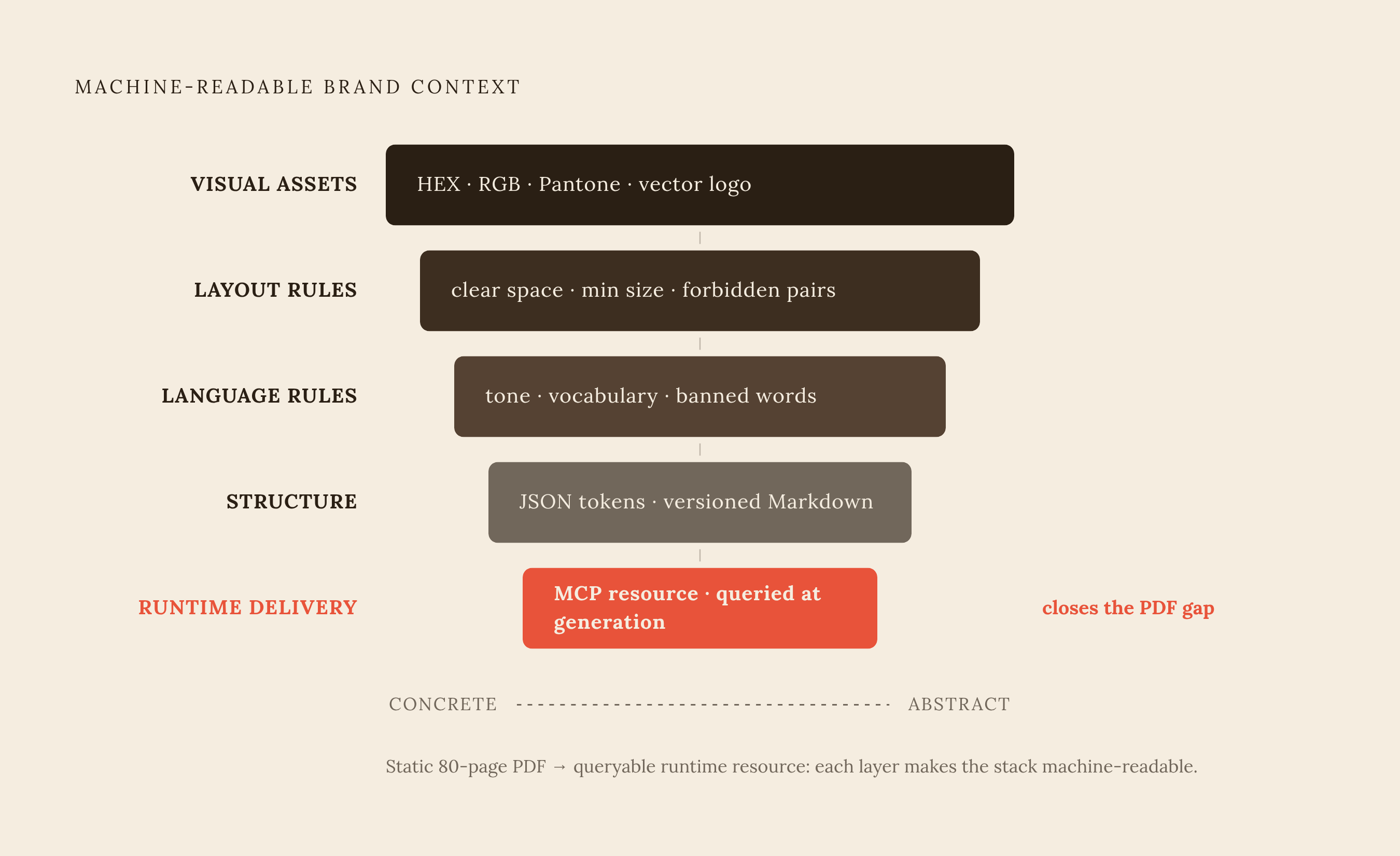
Machine-readable brand context consists of explicit, structured, versioned reference files. It includes vector logo variations, exact palette values in HEX, RGB, CMYK, and Pantone, approved typography and weights, and type hierarchy. It also defines logo clear space, minimum sizes, and forbidden combinations. Language needs equivalent precision. Tone, preferred vocabulary, banned words, brand persona, and legal claims must be available as rules.
Exact values replace subjective descriptions where a decision must be repeatable. “Navy Blue” leaves room for interpretation, while a hex code, contrast requirements, and approved background combinations constrain the choice. Pecia illustrates this structural approach by converting static guidelines into machine-readable datasets using JSON design tokens and structured data schemas. The format gives each rule an identifiable place. That makes the rule usable during both generation and review.
A lightweight implementation can use a folder of reference files with labeled sections for voice, visual identity, and positioning. MindStudio documents identity files injected at runtime according to the selected brand context. Markdown can also provide readable structure. SitecoreAI’s August 2026 brand context feature generates editable Markdown files from a website URL or an existing site. Beyond file format, a complete system needs three layers, which are the assets, the rules governing them, and the relationships that determine where each asset applies.
How MCP connects brand context to the agents building product pages
MCP is a protocol layer that lets agents get shared context. Its three primitives have distinct roles. Tools are callable functions, Resources are read-only data sources, and Prompts are reusable templates. A brand guide exposed as a Resource can supply the applicable voice or visual rules at generation time.
This shared interface also reduces integration fragmentation. Rather than building a separate connection for every assistant, a store can expose an MCP server to compliant clients. Shopify’s Winter’26 Edition made its Dev MCP Server available through Cursor, Claude, and the developer assistant on shopify.dev. Its documented capabilities include scaffolding apps, running GraphQL operations, and generating validated code across Admin, UI extensions, Liquid, and Hydrogen.
Sidekick app extensions, previewed in Winter’26 and fully released in Spring’26, let developers expose app data and actions to Sidekick. An app that holds brand assets or campaign records can use these extensions to make that information searchable within Shopify Admin. Availability alone does not establish authority, however. The governance requirement is that connected agents retrieve the appropriate brand context, rather than treating any accessible asset or instruction as an approved reference.
The asset production workflow that keeps every Shopify page on-brand
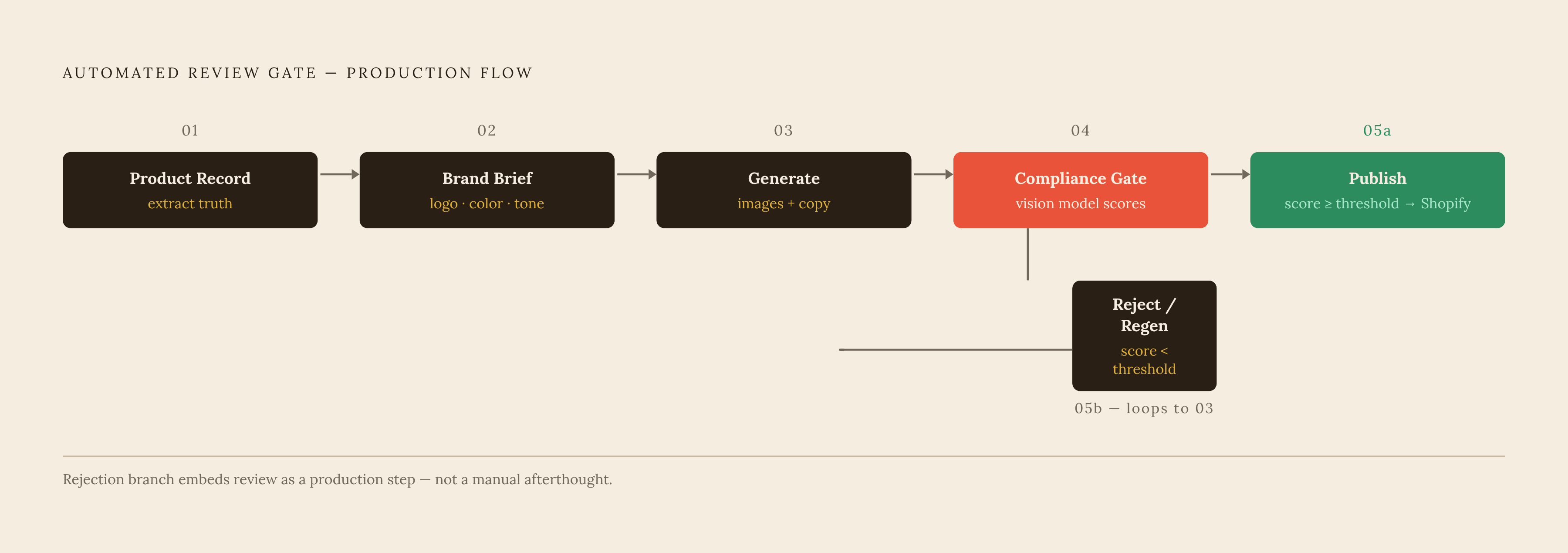
In practice, the workflow should begin with product truth. The agent extracts features, materials, variants, price, benefits, and claims from the product record. imini identifies this structured extraction as the foundation for its ecommerce workflow. Every asset made after that needs to draw on the same facts. Otherwise, a hero image, description, and ad concept can answer different questions about the same product.
Before generation, the agent should retrieve the applicable brand brief. That means querying the shared context for logo variants, color values, type hierarchy, tone rules, and vocabulary constraints for the product category and channel. The brief constrains the next production decisions. It turns a general request to make attractive content into a task governed by the merchant’s identity.
Image production then starts with a shot list covering clean hero, lifestyle, problem-solution, scale, feature callout, and bundle or variant images. Each image has a defined job. The agent uses the brand’s visual parameters instead of the defaults, while Photoroom can remove backgrounds and prepare images. Copy production uses the same product truth to connect features with buyer motivations, including problem relief, upgrade, gift, proof, comparison, and routine. Documented voice and vocabulary constrain how those motivations are expressed.
The last step is to check the work before it is published. A vision model compares generated assets against the brand kit and assigns a compliance score. Outputs below the defined threshold are rejected or regenerated. This gate makes review part of the workflow rather than a separate task someone must remember after generation. Its usefulness depends on whether the underlying rules are specific enough to test.
Detecting when AI output drifts off-brand before assets ship
The detection signals are deviations in color values, type usage, logo placement, copy tone, vocabulary, and claims. An asset can look polished and still violate the brand. Review must therefore compare the output with the applicable rules.
A team making hundreds of product pages per day cannot keep up with checking every color, logo, sentence, and word choice. Manual review becomes sampling. Samples can miss systematic drift, particularly when each mismatch is small enough to escape attention. Automated checks make those deviations visible across the production stream.
A practical audit records which brand rule was tested, what the asset shows, and whether it passes. A compliance score supports the release threshold. Below that threshold, the asset is rejected or regenerated, while the evidence gives a human reviewer something concrete to inspect. A pass-or-fail flag alone cannot show whether the problem is with typography, wording, or another rule.
The precision of the reference determines the precision of the audit. “Use a warm, conversational tone” leaves substantial room for judgment. “Avoid passive voice, avoid superlatives, use second-person address” supplies checkable criteria. Those rules need to belong to the actual brand, rather than being imposed as universal writing standards. Generation and review should use the same structured context so that approval tests the instructions the agent was meant to follow.
Keeping brand context current as the catalog and the brand both evolve
A static context can produce consistent work for an outdated brand. A palette refresh, revised tone guide, new logo variant, or changed legal claim must therefore propagate to every connected agent. Updating one document is not enough. If workflows keep their own copies, an agent that misses an update keeps making content with the old identity. Consistency requires shared updates as well as shared access.
The operational model is versioned brand context. Each change becomes a versioned commit, connected agents pick it up, and the history preserves what changed and when. Agencies and teams that run more than one brand need to keep those brands separate within that model. Each brand has its own authoritative context and update cycle, so one client’s rules do not enter another client’s output. Shared infrastructure must not become shared identity.
The practical test comes with the next brand change. Does every agent and product immediately work from the new version, or does someone have to remember to update each one? The former is infrastructure. The latter leaves consistency dependent on manual upkeep, even when production itself is automated.