Brand Context Layers in AI Creative Workflows for DTC Teams
Five structured layers give every AI agent one current brand spec.

Detecting when AI output drifts off-brand requires comparing finished creative against a shared, current specification of visual identity, voice, and channel rules. For DTC teams, brand context layers make that specification readable by both generating and reviewing agents. Consistency at scale is therefore a context infrastructure problem.
Brand consistency across AI creative workflows comes from giving every agent the same current, machine-readable brand specification instead of relying on prompts. That specification is organized into five layers: identity, style, narrative, context, and governance. It is exposed to agents through MCP, and to a team's own products through a REST API. The same source then guides generation and provides the criteria for reviewing output before it ships.
Why DTC teams shipping AI creative at volume hit a brand consistency wall
DTC teams in 2026 face creative demands across paid social, email, SEO, organic channels, and their websites that small in-house teams cannot meet manually. Each channel needs work that fits its audience and format, and each campaign needs fresh versions. AI becomes part of the production system. Yet faster production exposes a different constraint. Assets can each look polished but fail to look or sound like they come from the same brand.
The failure starts before an agent makes anything. Without brand context that stays with it, it uses general training data in place of the brand’s own rules. Logo treatments shift, palettes drift, and copy takes on a generic category voice. A better prompt can correct one session, but it cannot serve as shared brand memory across tools and teammates. DTC Multiplier’s 49-file context system captures voice, positioning, products, personas, and guardrails so that agents execute across channels from the same source. The distinction is not access to Claude or ChatGPT, but whether the knowledge behind one person’s effective workflow is documented and available to everyone else.
What "brand context" actually means when AI agents are doing the generating
Machine-readable brand context puts the brand’s guidance into values, constraints, and fields that an agent can use. A static PDF may explain the brand to a person, but it is not itself a queryable source of current rules. Design tokens give agents values they can use in place of swatches they have to interpret. Voice rules translate a direction such as “sophisticated” into sentence length constraints, banned buzzwords, and required terminology.
The same distinction applies to content and assets. Structured content models give agents fields to read, while metadata and taxonomy make assets findable and attributable without relying on someone’s memory of a folder. Context must answer a task. That changes the role of the brand kit from a document maintained for human reference to a queryable, versioned system. Any connected agent can then consult the relevant rules before generating, rather than reconstructing them from whatever material happens to be in its session.
The five-layer architecture that makes brand context agent-readable
Most brands already possess much of this material. It sits across Figma, Notion, a brand deck, campaign documents, and the knowledge of individual team members. The missing element is often the architecture that separates different kinds of instruction while preserving their relationships. Five discrete, interdependent layers provide that structure. They let an agent query the rules relevant to its task without treating the whole brand as one undifferentiated document.
The identity layer contains logos, colors, type, and shapes, which are the fixed visual elements that must survive changes in channel and format. The style layer governs visual references, image direction, and in-house trained models, extending the brand’s aesthetic into generated imagery. These layers serve different purposes. An image can follow the right aesthetic direction while using the wrong palette, so style cannot substitute for identity. Both are necessary to distinguish an attractive asset from a brand-correct one.
The narrative layer defines system prompts, tone of voice, and lexicon as requirements and constraints. The context layer specifies how those rules flex across channels, formats, audiences, and funnel stages. The governance layer covers approval workflows, usage rights, and versioning so that the other layers remain authoritative. Their dependencies are equally important. Narrative without context can produce copy that sounds right but belongs in the wrong channel, while rules without governance can remain available long after they have been superseded.
Why the context layer specifically is where most DTC teams lose cross-channel consistency
A Meta ad, product page, TikTok script, and launch deck do not need identical language or presentation to belong to the same brand. They need an explicit variation system that connects channel requirements to identity and narrative. Without it, each agent supplies its own interpretation of what is appropriate.
That gap is visible in the work of agents with different specialties operating at the same time. Social content, email flows, paid creative, SEO articles, and performance reporting each run through their own workflows. Channel rules may exist in Figma, a CMS, Notion, Confluence, or decks, but access to those documents does not establish which one has authority. Conflicting instructions can therefore produce conflicting output. Knowledge of what counts as on-brand for TikTok rather than email often remains unwritten, leaving no rule an agent can reliably apply.
Growth agents need first-party audience data alongside the rules for on-brand creative, with customer knowledge and brand guidance brought together. Unifying them gives agents a common picture of the customer and the brand for that channel. This information lets an agent adapt the brand without inventing its own version of it.
How MCP turns brand context layers into something every agent can query in real time
A shared brand source needs a connection to the agents producing the work. Model Context Protocol, or MCP, lets a server expose voice rules, visual identity, positioning, and channel-specific requirements for compatible tools to query before generation. Anthropic open-sourced MCP in November 2024. Instead of maintaining separate briefs inside Claude, ChatGPT, or Cursor, a team can make the same context available through a common connection.
Canva’s MCP AI Connector lets agents create and edit designs, manage brand assets, search existing designs in a Canva account, and export in multiple formats. Figma shipped an official MCP server in 2025, with expanded capabilities rolling out into 2026. These connections bring design execution into agent workflows, where structured brand context can inform the work.
Amazon Ads launched an MCP server in open beta on February 2, 2026, for campaign creation, performance reporting, and account management through natural language prompts. Campaign creation, ad group configuration, and ad building remain separate API calls orchestrated by the agent. For document retrieval, Notion and Google Drive MCP servers let Claude pull an ICP document, brand voice profile, or content calendar by name. The Google Drive server is in Developer Preview and requires a Claude paid plan plus OAuth configuration. Connection does not mean frictionless operation.
Scalekit’s benchmark found lower reliability for MCP than CLI, with failures caused by TCP timeouts. Its finding about increasing tool counts concerned token and cost overhead. A common protocol reduces the need to rebuild integrations for each compatible tool, but it does not eliminate operational failure. Nor does connecting a scattered document collection make its contents authoritative.
Versioning brand context the way code is versioned — and why it matters when the brand changes
A rebrand exposes the cost of stale context. When a palette, voice, or positioning changes, agents connected to old instructions can keep producing the previous brand. Agents using old instructions split output across channels precisely when the new identity needs coordinated expression. Governance prevents that split from becoming the default. Named authoritative sources, owners, conflict rules, and retirement of outdated content make updates usable across the system.
Superside’s work on the Maven Clinic rebrand makes the production requirement concrete. Superside assembled a high-quality data set, trained a custom AI image model, and delivered an on-brand Figma plugin for Maven’s team. The updated brand was therefore expressed through structured inputs and a production tool, rather than left solely in a reference document. That is the practical purpose of updatable context. Brand changes need to reach the systems creating assets.
Brand updates should be treated like versioned changes in code. Every connected agent should pick up the current version when the source changes. The analogy need not extend further. Its useful point is that a change has an authoritative version that replaces what came before. Without that discipline, the alternative is manual correction across the assets generated from outdated instructions.
How do you maintain brand consistency across AI creative workflows?
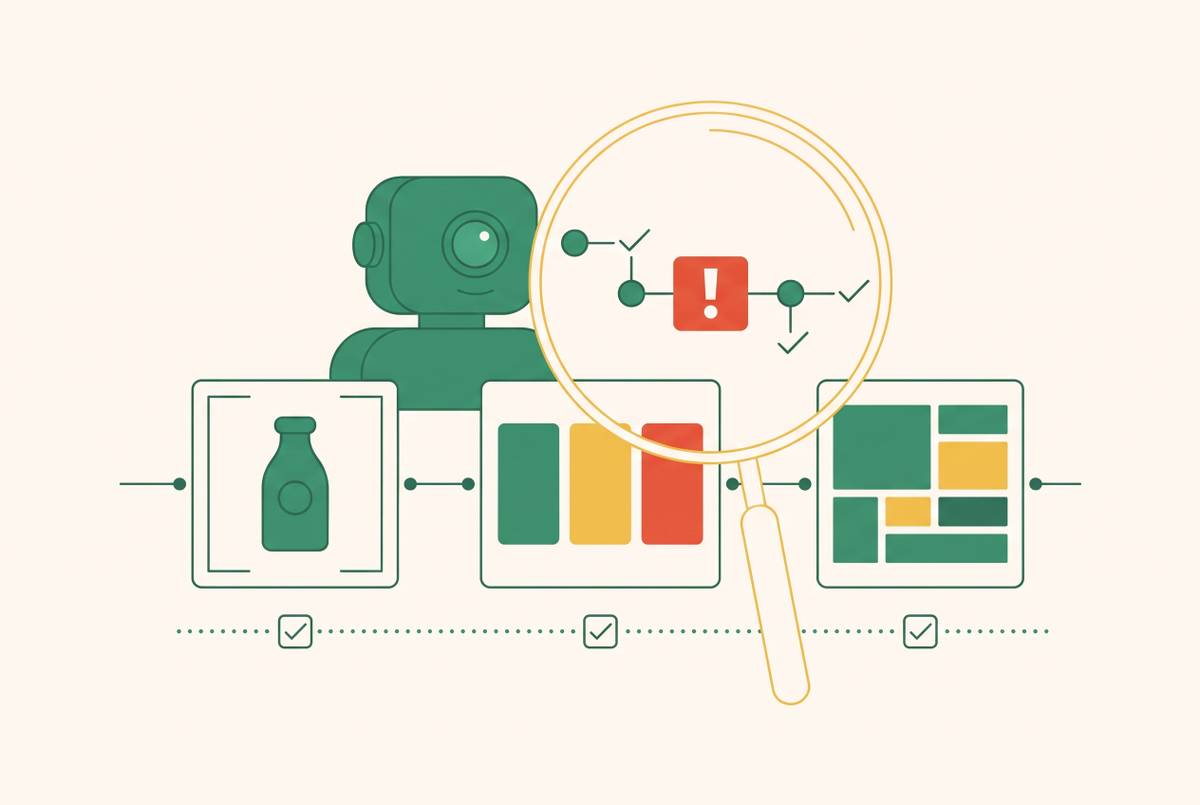
Warning signs include changed logo treatment, incorrect type or colors, imagery that departs from the approved direction, prohibited vocabulary, and missing required terminology. Channel mismatches are another signal. Copy can follow voice rules but fail to fit the format, audience, or funnel stage it was written for. A review that checks only whether the asset “sounds right” misses that distinction.
The identity layer holds the rules for logo, type, and color, while style sets the direction for imagery. Narrative sets the limits on voice and lexicon, and context sets out what to check for each channel. Each finding can be tied to a requirement. That makes the review useful for enforcing tone and voice across many outputs, because the standard is an explicit rule rather than a reviewer’s personal reading of an adjective.
The same specification must govern generation and review. Otherwise, the reviewing agent may reject work using different or outdated instructions, creating another consistency problem. At DTC production volumes, manual inspection of every asset recreates the bottleneck AI was intended to remove. Automated comparison against current context closes the infrastructure loop. Context guides the work first, then provides the criteria for checking it before release.
What it takes to make brand context a shared layer across multiple agents and products
Copies turn into separate versions, while connected systems keep going to the shared layer for their rules. For agencies and multi-brand operators, that source must also preserve brand boundaries. Each brand needs its own identity, style, narrative, context, and governance. An update for one brand must not reach another, and retired campaign assets must not resurface in current work.
Two connection patterns serve different implementation needs. MCP supports agent workflows through compatible tools such as Claude, ChatGPT, Claude Code, Cursor, and Codex. A REST API supports teams embedding brand context into their own products, where access must exist beyond an individual agent session. Both patterns should draw from the same source. This lets a brand update reach connected agents and integrated products without separate per-tool configurations.
Brand management cannot be an afterthought attached to content generation, because the source needs ownership and update rules to remain trustworthy. As brand count grows, governance becomes more exacting. Implementation requires making the right brand’s current context available wherever that brand is being expressed.
Where to start — moving from scattered brand files to a structured context layer
Begin an audit of existing materials by mapping the Figma files, brand decks, Notion documents, style guides, and past campaign briefs that currently hold brand knowledge. Identify conflicts, gaps, and stale content before connecting more workflows to them. Most teams are not starting from nothing. The audit reveals which materials can become authoritative context and which need correction or retirement.
Next, structure identity and narrative in machine-readable formats, beginning with logos, colors, type, and explicit voice rules. These layers address the most common visual and verbal failures. Then document how the brand changes across paid social, email, and product pages in the context layer. Before scaling output, assign ownership, name authoritative sources, and establish the update process.
Connect agents through MCP and products through an API so that each workflow can reach the shared context without rebuilding it. A working version is enough to begin. The system can improve over time as the brand develops, provided ownership and updates are already part of its operation. The choice is between brand context built as infrastructure that every agent reads and a prompt that disappears at the end of every session.