Tone and Voice Enforcement Tools That Work Across Every AI Output in a DTC Creative Stack
Centralized brand profiles keep AI outputs consistent across multiple creative tools.
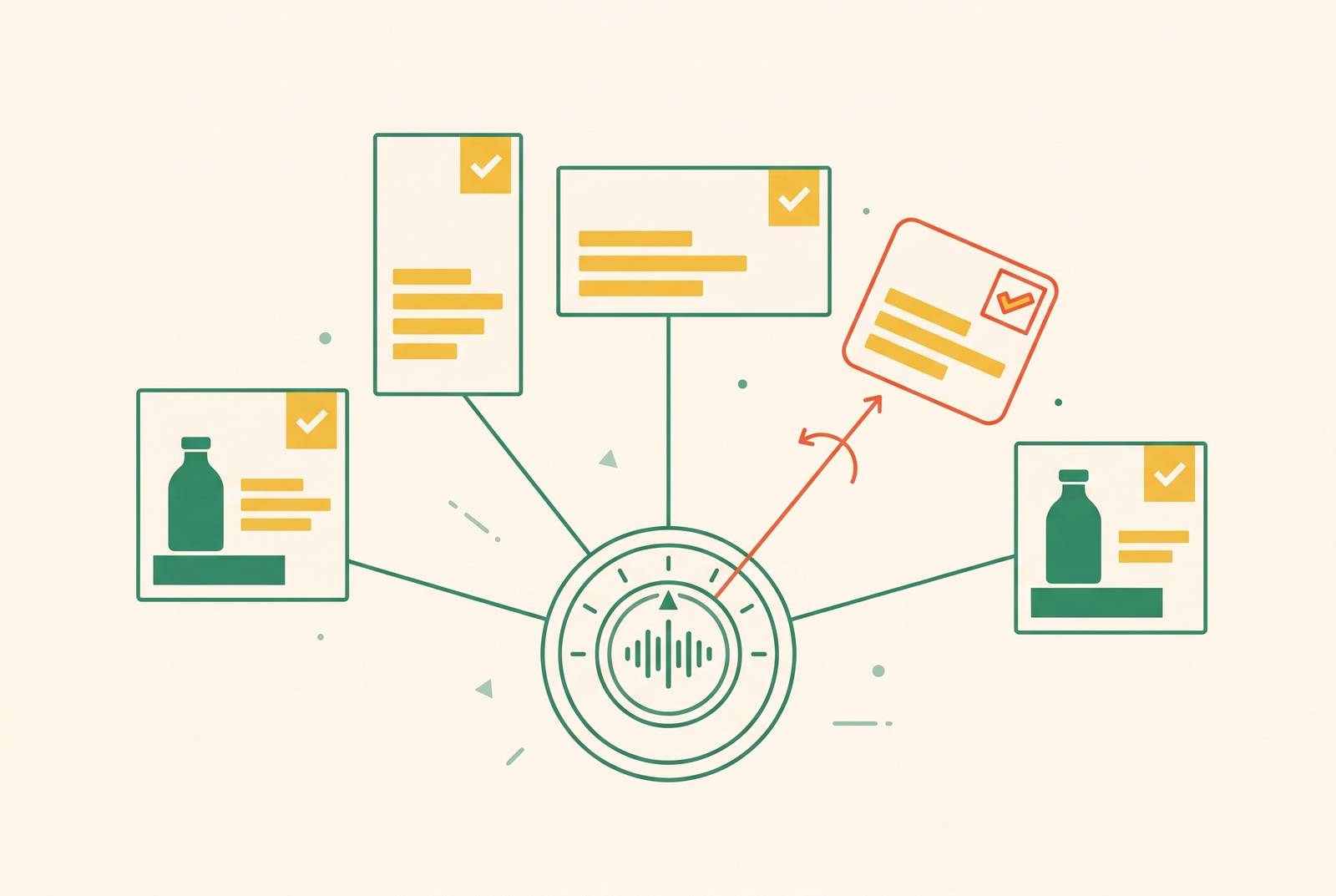
To detect when AI output drifts off-brand, finished work must be checked against a shared, machine-readable brand profile before it is published. Across a DTC creative stack, per-tool prompts and style guide PDFs cannot provide that shared standard. To enforce tone and voice, every agent that generates work needs access to central brand context, and a pre-publish review gate must check both how the work is written and whether its facts are right.
Why tone and voice drift is a structural problem, not a prompt quality problem
A DTC creative stack distributes production across tools, people, and skill levels. Each participant interprets the guidelines separately, so a shared document does not produce a shared operating standard. Small differences accumulate in vocabulary, sentence structure, and register. An output can look acceptable alone while contributing to a fragmented brand across channels.
A static style guide leaves much of this interpretation unresolved. Words such as “innovative” and “warm” describe an intention without specifying the language that should express it. Different models and users can read those adjectives in different ways, with no clear way to tell which reading is right. The document defines an aspiration. Its apparent consistency hides the variation introduced every time someone translates it into a prompt.
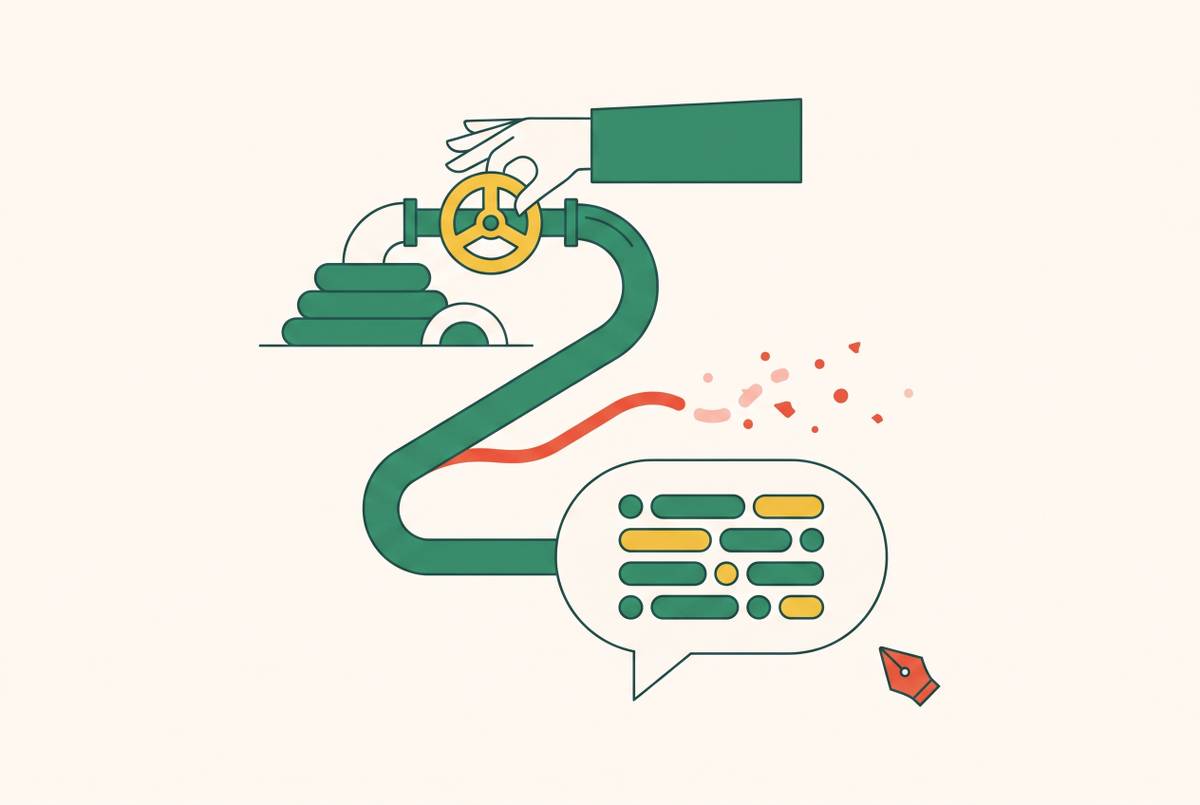
Tighter prompt templates can reduce local variation, but they do not resolve the separation between tools. Each invocation starts with the context it is given, with no shared state across channels or agents. Prompt quality has a limit: a template revision affects only the application in which it is made. The root cause is architectural because a definition written once for humans is reinterpreted independently at every point of production.
What a machine-readable brand voice profile actually contains
A machine-readable voice profile turns descriptions into explicit constraints that generation and review systems can apply. It defines tone ranges by scenario, sentence structure rules, required and banned terminology, and canonical examples of on-brand and off-brand phrasing. Those examples give the rules a concrete reference. Instead of asking a model to infer what “friendly” means, the profile specifies the language choices that express friendliness and the situations where they belong.
Klaviyo’s AI Customer Agent illustrates this translation through four tones, namely Neutral, Professional, Friendly, and Playful. Klaviyo defined Friendly through rules including contractions, avoidance of overly formal or impersonal language, occasional exclamation points, and a warm closing that invites further questions. These are observable choices rather than mood labels. Its evaluations found distinct outputs under testing for the different rulesets. That translation was separate from the placement of tone instructions in the system prompt, which later caused them to override functional constraints.
Hex codes alone cannot define composition, photography depth of field, or lighting, so a complete profile includes those parameters as well. Facts require their own approved reference set. The profile therefore pairs its expressive rules with a curated, versioned source library containing product documents, positioning statements, FAQs, and proof points. This separates how the brand communicates from what its agents are allowed to claim.
Why a central brand context layer outperforms per-tool configuration
Pasting that profile into every tool’s system prompt gives each application its own copy to keep up to date. The format has improved, but the separation remains. A brand change still means updating every surface, and when an update is late, the instructions can conflict. A central brand context layer instead provides a persistent, authoritative source that connected agents query before generation. Changes propagate through that shared source.
Centralization must cover scope, priority, and vocabulary. Klaviyo used tone controls only for marketing-oriented interactions, leaving out service and internal use cases, and an inquiry answered in a Playful tone shows why that limit is needed. The customer’s situation changes what language is appropriate. A tone suited to marketing can create dissonance when the person receiving it is frustrated about an order.
Klaviyo also found that attaching tone instructions to the system prompt could override functional requirements, including SMS character limits and product links. Its universal requirement prompt put core behavior ahead of personality. Klaviyo described scoping as its most important design decision and functional priority as its most valuable lesson. The distinction is useful for the architecture. Scope sets where a tone applies, while priority ranks style and function when they conflict.
For a multi-tool stack, those decisions belong in the shared context architecture rather than in independent interpretations within each application. Otherwise, identical voice rules can still produce inconsistent behavior because the surrounding priorities differ. Shared wording alone is not enough for enforcement. The central layer must also define where that wording applies and which requirements it cannot override.
How MCP makes brand context available to every agent in the stack
Model Context Protocol, or MCP, provides a standard way for compatible agents to access external context and tools. Anthropic open-sourced MCP on November 25, 2024. By 2026, its ecosystem covers Claude, ChatGPT, Cursor, Visual Studio Code, and agent frameworks and developer tools. MCPJam serves a testing and evaluation role for MCP servers rather than acting as another general-purpose assistant. The ecosystem also includes connections to sources such as Notion and Google Drive.
For brand enforcement, an MCP server exposes the profile’s voice rules, visual identity tokens, positioning, terminology, and channel variations. Compatible agents can query the same material instead of relying on context rebuilt separately for each session. The connection makes the shared source accessible. The workflow must still require that agents consult it before generation, because access to brand rules is not itself proof that an output followed them.
The setup pattern for marketers is to connect Claude, or another compatible agent, to the server URL and authenticate. In Claude, that makes the context available in-thread across Claude.ai, Claude desktop, and Claude Code without rebuilding it per session. A copy agent and a design agent can draw on different parts of the same profile while retaining a common reference for brand decisions.
That coordination has a cost in tokens and complexity. For a team using one agent on one surface, per-tool configuration may be simpler. MCP earns its cost when rich, multidimensional brand context is shared across three or more tools. A DTC stack that makes copy, images, and email at the same time fits that pattern, because each kind of output needs the same brand definition.
Applying the context layer across the surfaces that matter in a DTC stack
For copy and email, the shared profile becomes a set of guardrails for tone by funnel stage, terminology, sentence structure, and CTA formats. SMS character limits, email nurture pacing, and ad copy brevity belong in channel-specific parameters. The common foundation makes each variation a defined response to the surface.
Images require more than a verbal instruction to look on-brand. Photoroom’s July 2026 study found that the best base image-editing model preserved full product details in fewer than a third of generations, while nearly three-quarters contained at least one visible error. Some logos were warped, some elements were missing, and some colors had shifted. Product fidelity is therefore a separate constraint. A brand model library anchors campaign consistency through trained visual references, including LoRA fine-tunes for recurring faces or environments and a locked seed for lighting and color grade.
Figma and Canva shipped MCP-compatible integrations in 2026. Figma’s server lets agents pull design variables and components and write back to the canvas. Canva’s AI Connector lets agents create and edit designs, access brand kits and templates, and export in multiple formats. These connections make design context available to generation workflows, although they do not remove the need to check finished work.
Video uses the same principle through source material. The hybrid DTC approach anchors production in one or two hero editorial shoots per year, then uses AI for variants, cut-downs, and localization. The constraint is the approved material itself. Rather than generating everything from scratch, the workflow extends a defined visual foundation across the long tail of campaign output.
Detecting when AI output drifts off-brand through pre-publish review
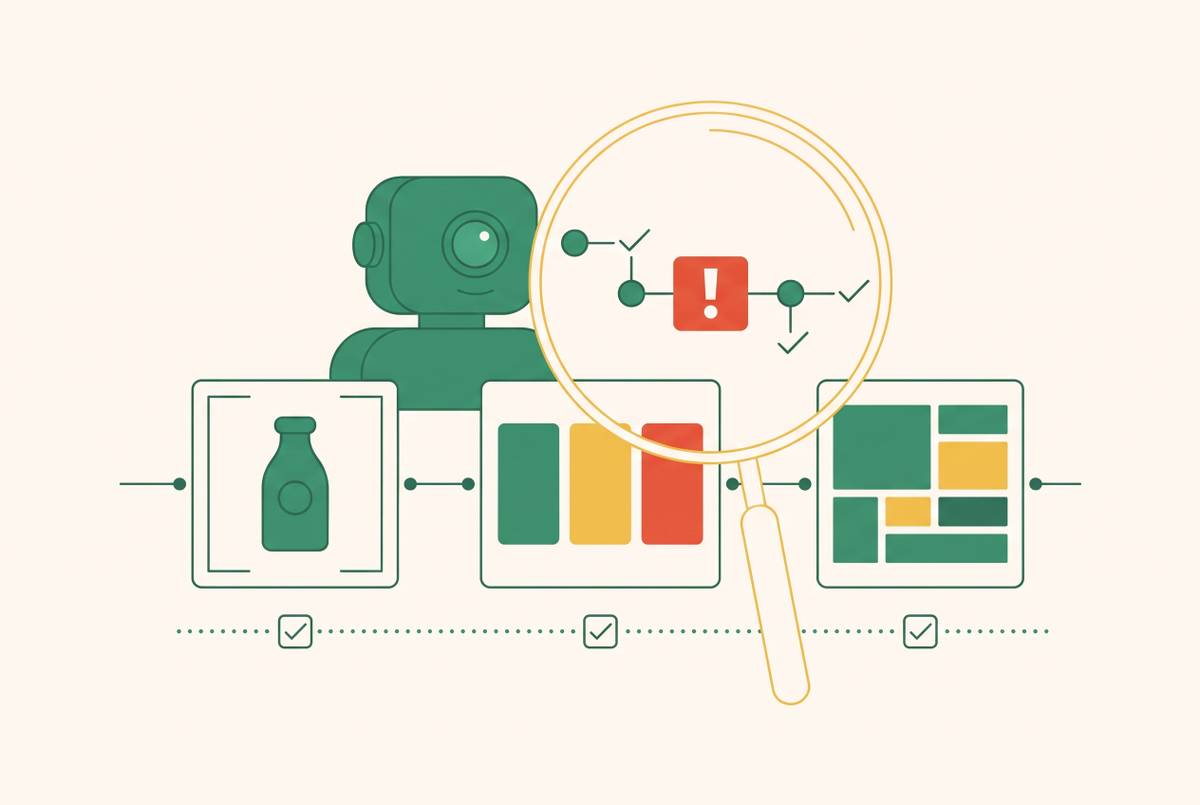
Finished work must be checked against the same profile that governed its creation, with evidence for each check. An LLM-as-a-judge can evaluate tone alignment, correctness preservation, and tone distinction. Each dimension asks a different question. The review tests whether the output follows the requested voice, preserves approved facts, and remains distinguishable from generic copy.
Klaviyo uses those three dimensions to check responses and track how style and correctness affect each other. Its approach also catches regressions after model updates, which can shift output behavior without any change to the brand instructions. Running the checks again can reveal when a generation pattern that used to pass no longer fits the profile.
Product claims, pricing, and category comparisons must be grounded in the approved source library, while new or high-risk assertions go to human review before publication. Versioning makes those decisions traceable over time. Prompts, templates, voice profiles, and brand artifacts need tracked versions so that a regression can be connected to the change that introduced it.
The resulting brand-quality scorecard tracks exception rate, rework rate, and time-to-publish against a human-edited control. This replaces “feels on-brand” with evidence about quality and operational cost. Review is therefore not merely a publishing delay. It is the mechanism that earns the right to scale autonomy, showing which content types can move toward no-touch production and which still require human approval.
Building the enforcement layer in a DTC stack and what to do in sequence
The practical sequence begins by converting the style guide into the profile that both generation and review will use. Replace lists of adjectives with tone ranges for each scenario, rules for sentences and terminology, and pairs of on-brand and off-brand examples. Add the versioned source library at this stage. The review gate will need approved product documents, positioning, FAQs, and proof points to distinguish acceptable expression from unsupported claims.
Use design tokens in place of color names and entries in the component library in place of screenshot references. Turn adjectives about photography into composition ratios and lighting parameters. These definitions become inputs for the shared layer. Completing them before deployment gives copy and visual agents a common foundation without forcing either surface to rely on rules written for the other.
Then deploy the profile through a shared context layer over MCP and connect the copy, image, email, and design agents. Define tone scope at the same time. Marketing-oriented interactions receive the full voice profile, while service and support interactions are excluded from those tone settings to prevent inappropriate personality from taking precedence over the customer’s situation.
After connection, add the pre-publish validation gate to every output. Use an LLM-as-a-judge to check tone alignment, claim accuracy, and vocabulary compliance against the shared profile, routing exceptions to human review. Log every pass and fail for the scorecard. Treat subsequent changes to prompts, templates, and brand context as versioned updates that connected agents pick up, so the operating standard stays current without silent overrides.
Finally, pilot the workflow on a low-risk content type such as blog intros or email subject lines. Compare its output with a human-edited control and track exception rate, rework rate, and time-to-publish. Expansion should follow evidence rather than production volume. Those results show when no-touch production can cover higher-risk content types and where a human must still approve the work before it is published.