Per-Brand Tone Rules Are a Runtime Resource Requirement Not a Style Guide Attachment
Agents write in the voice they're given at generation time, not the one in the style guide.

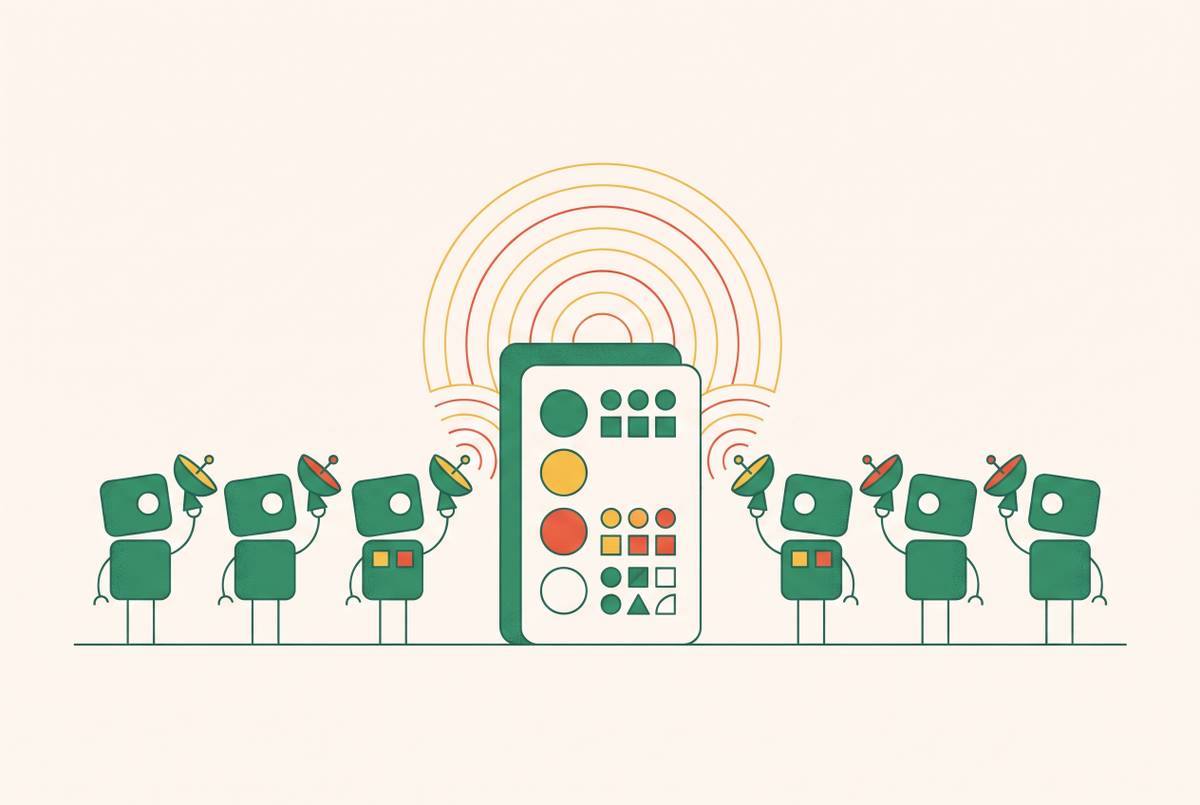
Per-brand tone rules are a runtime resource requirement. Agencies keep brands distinct when each agent gets structured, versioned rules at generation time, with hard boundaries between clients. A guide stored outside that workflow cannot govern output reliably, because the agent generates from the context it receives.
Why AI agents drift off-brand even when a style guide exists
Teams can have detailed brand documentation and still get AI output that varies from one run to the next. The guide may set out the voice, explain positioning, and have approved examples, yet the copy could belong to almost any brand. The missing element is often not better documentation. It is a reliable connection between the documented rules and the moment the agent writes. A PDF attachment, Notion page, or shared document does not establish that connection by itself.
Without that connection, a person must select the relevant guidance and paste it into a prompt. At each handoff, someone chooses how to read the guidance, because one team member may focus on personality while another adds terminology or channel guidance. A human-readable instruction such as “friendly, approachable” adds another source of variance. It describes a desired impression without specifying the behavior that should produce it. Even when everyone consults the same guide, they may give the agent different instructions.
The resulting drift is an architectural failure rather than evidence that the agent cannot follow a brand voice. Without explicit constraints at generation time, the model tends toward statistical averages from its training data. The brand’s intended voice competes with the other voices represented there.
How inference-time context actually determines what an agent produces
An agent’s output depends jointly on its model weights and the context available when generation begins. The weights contain what the model learned during training, while the context window contains the instructions and information available for the current task. That distinction explains why document location is consequential. Runtime guidance outside the context window has no direct pathway into the generation. The model cannot apply a rule merely because the organization has published it.
What enters that window is a runtime decision. A system prompt can give the agent standing instructions, retrieved passages can give it selected guidance, and injected resources can give it structured brand rules. If none of these delivers the relevant constraints, the generation proceeds without them. A manually pasted excerpt may help, but it may also be incomplete, stale, or different from the excerpt another team member uses.
The form of the delivered guidance is equally important. An aspiration such as warmth leaves the model to decide how warmth should sound. Instructions to use contractions, limit sentences to 20 words, and address the reader as “you” specify observable behavior instead. Those rules can guide generation and give teams a way to check the work afterward. A runtime resource is brand guidance made machine-readable and available at this point of use, rather than a document waiting for someone to interpret and transfer it.
What "runtime resource" means in structural terms
A tone rule becomes a runtime resource when it is structured for machine consumption, versioned, and injectable through a standard protocol at generation time. These are separate requirements. Structure gives a system rules it can parse and retrieve, rather than prose that requires an intermediary to translate it. Versioning establishes which guidance is current. Runtime injection puts that guidance into the agent’s working context when it is needed.
The emerging file primitives brand.json and brand.md illustrate this structural shift. They provide a form for tone rules, voice parameters, and visual constraints that AI tools touching a project can consume. The file name alone changes nothing. The file must have guidance the agent can use, and the workflow must retrieve it into the agent’s context. The resource’s role is to supply execution context.
A canonical location also changes how updates reach agents. When tone guidance changes, downstream agents draw from the updated resource instead of relying on copies embedded in individual prompts. The practical distinction is dependency on human memory. If a person must remember to include a rule, it remains reference material in that workflow. If the system retrieves and applies it for the brand’s generations, it functions as a runtime resource.
Why MCP is the delivery mechanism that makes runtime injection practical
Anthropic’s Model Context Protocol announcement defines MCP as an open standard for connecting AI systems with data sources. For brand operations, its value is specific. It gives compatible agents a shared way to connect to structured brand context, taking the place of an integration built for each agent. A brand resource can therefore be exposed centrally through a server shared by the tools.
MCP provides three primitives relevant to that connection. Resources expose read-only data, including tone rules, color values, and logo usage constraints. Tools provide functions an agent can call, such as retrieving a brief for a content type. Prompts provide reusable templates that shape how an agent approaches a brand task. These functions serve different purposes, but together they let a workflow deliver both stable brand guidance and instructions specific to the work.
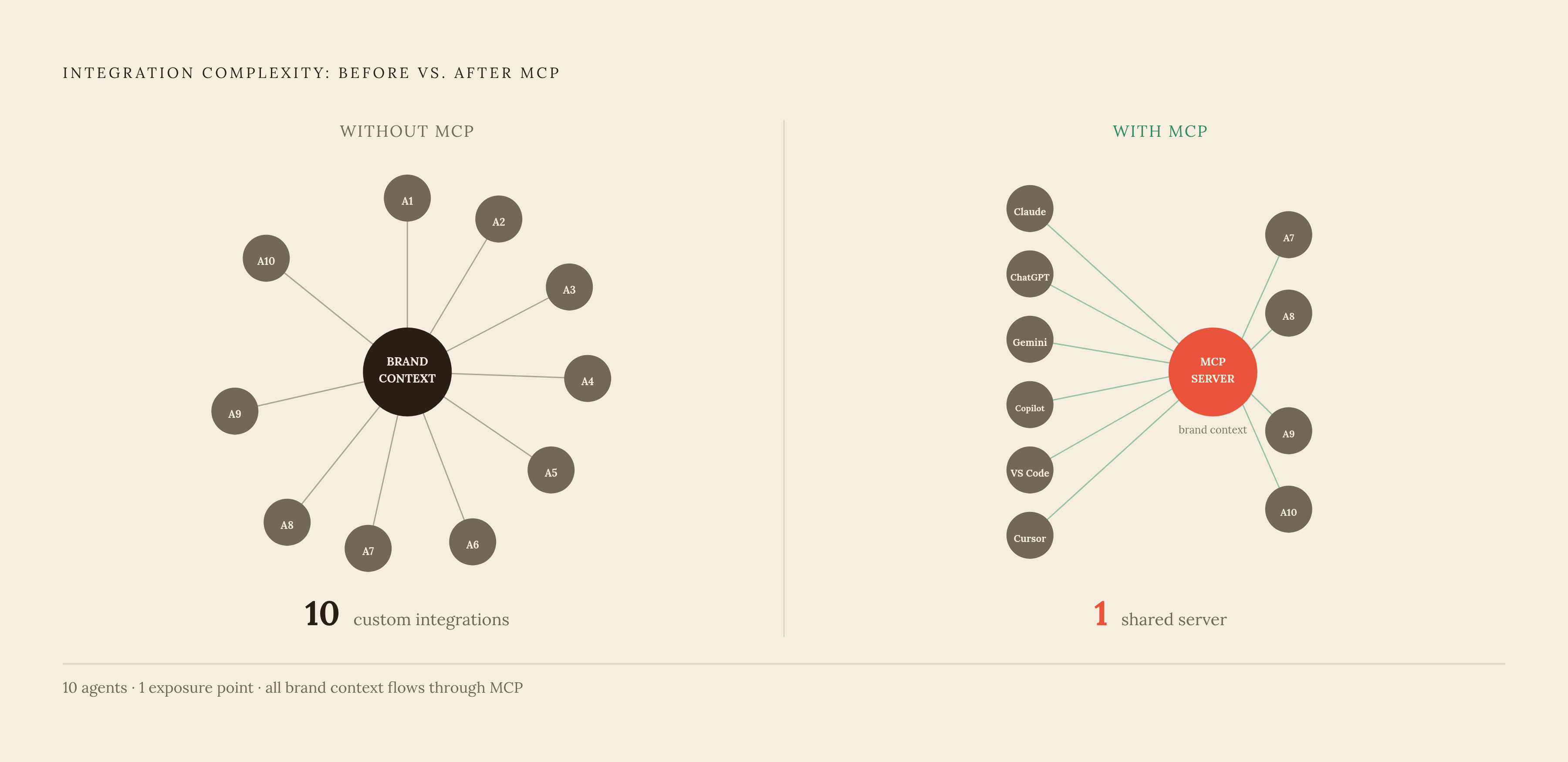
Without a shared protocol, 10 agents need 10 custom integrations to connect to brand context. With MCP, the brand exposes one server to which compatible agents connect. Native support spans Claude, ChatGPT, Gemini, Microsoft Copilot, VS Code, and Cursor, making that connection relevant across the tools marketing and product teams use.
The protocol supplies delivery. The workflow still needs the correct resource and must bring it into context before generation. In that arrangement, the server exposes guidance the agent reads directly as it works.
How do agency handoffs cause brand drift, and what prevents it?
When one agent platform serves multiple brands, missing context boundaries turn tone drift into brand bleed. The underlying model and infrastructure can remain the same. The system prompt, tone configuration, policy rules, and data scope must differ by brand. Without those boundaries, an agent can use one client’s voice when it writes another client’s copy.
Agency handoffs make this failure concrete. A team may pass a task to an agent without switching the brand resource, or may supply a stale excerpt inherited from an earlier workflow. The next person sees a task labeled for Brand B, while the agent still gets guidance for Brand A. The label does not repair the context. If separation depends on everyone remembering the right manual step, volume, deadlines, and team turnover make that arrangement unreliable.
Hard boundaries must extend beyond writing style. Each brand’s customers, assets, tone rules, and conversation history belong within that brand’s scope. Keeping them distinct is a correctness requirement. A shared platform is compatible with separate brand identities only when its resources preserve that separation.
For agencies, centralization therefore means one source of truth per brand. Each resource has the brand’s tone guidance, visual identity constraints, and AI-ready context. As the client roster grows, shared delivery infrastructure can reduce fragmented integrations while resource-level isolation prevents the convenience of sharing from becoming cross-brand contamination.
How the volume of AI-generated creative breaks review-based brand governance
Human review can keep work on-brand when there is little enough to check. A reviewer catches off-brand language, asks for changes, and approves the work once it is fixed. Early AI adoption often preserves this familiar arrangement. Generation becomes faster, while the same review process remains at the end of the pipeline. The mismatch occurs when output expands beyond what reviewers can assess at the same pace.
At that point, review becomes the production bottleneck. More generations bring more chances for tone to drift, and each fix sends the work through the workflow again. The time saved in creating the work goes into fixing it. This is a reason to retain final sign-off while distinguishing reviewing finished work from repeatedly supplying constraints that should have shaped the work before it existed.
Visual generation adds to the correction burden. Without brand context, a base model can produce warped logos, missing elements, and color shifts because the required constraints were absent. Reviewing those outputs afterward addresses the consequences of the missing context layer one output at a time.
The architectural response is to move brand constraints into generation-time context. Review then checks finished work against the same structured resource used to produce it. Evidence per rule replaces a process governed only by each reviewer’s interpretation. Final sign-off still has a role, with other checks now helping to keep every generation recognizably on-brand.
How to translate a style guide into a machine-enforceable brand resource
For teams making this conversion, the first task is to replace aspirational descriptions with behavioral constraints. “Friendly and approachable” describes an impression. “Use contractions” specifies a writing behavior. A sentence-length limit of 20 words supplies a measurable boundary, while an instruction to address the reader as “you” defines the relationship the copy should establish. An enumerated set of prohibited terms makes vocabulary restrictions explicit.
Checkability is the dividing line. A tone rule that cannot be checked automatically against an output has not yet been translated into an enforceable runtime constraint. The resource must connect brand personality to instructions an agent can apply and a review step can assess. Otherwise, the guide’s ambiguity simply moves into a different file format.
Copy guidance needs three clear layers, which are core personality, platform tone, and the task brief. Core personality contains the values and point of view that remain stable across channels. Platform tone defines channel-specific adjustments, because LinkedIn requires more context and a calmer register, while a short-form channel rewards faster pacing and more personality. The task brief supplies constraints for the particular generation, drawn from the brand resource and scoped to the content type.
For images and video, the equivalent foundation is a pinned canonical reference set of on-brand assets wired into downstream generation. Video offers a particularly direct starting point. Generating or uploading an on-brand still image before using image-to-video supplies the model with an on-brand first frame. These visual constraints join the tone rules and voice parameters in the structured resource that an MCP server exposes.
What shared brand context across agents looks like as operating infrastructure
A working brand context layer has the properties teams expect from operating infrastructure, including a single source of truth, versioned updates, and a shared current state. Brand identity lives in the structured resource rather than in disconnected prompt files or agent-specific copies. Each brand retains its own boundary. The shared layer connects agents to the appropriate resource without merging the identities those resources describe.
A coding assistant, campaign generator, social copy tool, and deck builder can ask an MCP server for the same brand state. They perform different tasks and may need different briefs, but their tone rules and visual constraints come from the same source. When that source changes, connected workflows draw from the new version automatically.
Review completes the system by checking work against that same resource. Generation and evaluation no longer depend on each reading the upstream document in its own way. The resource supplies the standard for both, with evidence per rule supporting the review decision. This keeps human sign-off connected to explicit requirements rather than making reviewers reconstruct the brand’s intent for each output.
The operational shift is from correcting isolated outputs to governing their production. Brand context belongs in the same category of architectural decision as a database or version control system, because downstream work depends on its state and availability. An agency with several clients needs every agent to get the right brand’s current rules at the moment it acts. That is an infrastructure requirement a style guide attachment cannot fulfill.