AI Agents Do Not Ignore Brand Standards They Were Never Given a Feed They Could Subscribe To
Brand rules must be structured, governed, and delivered live to agents.

For AI agents to use existing brand guidelines and systems, brand must be published as structured, versioned context that agents can query at runtime. A governed source of truth sets out which rules apply, and a context-sharing protocol is the delivery layer between brand systems and agent workflows. Off-brand output is a consequence of requiring machines to interpret documents without an authoritative feed they can use.
Why AI agents produce off-brand output even when brand guidelines exist
Teams assume an agent should know the brand because they have supplied the brand guidelines. In practice, the agent may have received a PDF written for people who already understand the organization’s products, audiences, and conventions. Those are not equivalent forms of knowledge. A person can fill gaps through what they know or by talking with a brand manager, but the agent works from whatever context it gets. The mismatch begins before generation.
Traditional brand governance depended on a small, controlled production pipeline. Designers made materials, brand managers checked them, and approved work went into use. That process could accommodate rules left implicit because human review supplied the missing interpretation. Generative agents introduce variability even across identical situations, so those omissions become harder to contain as production expands. What looks like disregard for standards is often an agent interpreting incomplete instructions.
What "brand as document" actually means in practice, and why it fails at AI scale
A shared PDF does not produce a shared instruction. One team member asks for “professional and punchy” copy, while another asks for “friendly and casual” copy from the same guidelines. Each has translated the document independently. Without constraints the model can act on, a generic marketing voice fills the gaps between those interpretations. The same weakness occurs in visual work when image tools get a screenshot of a mood board instead of structured parameters for colors and style.
Volume makes this inconsistency difficult to catch. A team generating dozens of ad creatives, social posts, and blog variants in an afternoon cannot send every output through the old human review process without sacrificing the velocity AI promises. For a consumer brand producing across Meta, Google, TikTok, LinkedIn, and its website, the failure can appear as stretched logos, fuzzy palettes, random typography, and off-tone copy. So inconsistent work can reach publishing channels before anyone spots a pattern.
Shadow content bypasses even that strained review process. Individual contributors can use generative tools outside governed workflows, sending unreviewed material directly to publishing channels without passing through the enterprise digital asset management system, or DAM. No governance record accompanies that content, and traceability is lost. The structural gap is the missing connector between the brand system and the creative tool. Keeping guidelines in a central location does little for a workflow that never consults them.
How do existing brand guidelines become a feed AI agents can use?
Brand becomes agent-ready when its rules are expressed as data a machine can read, query, and act on without human interpretation. Design tokens replace descriptive color guidelines with structured JSON covering colors, typography, spacing, and layout rules. Component libraries replace screenshots as the source of reusable elements, while structured content models replace Word documents. Explicit metadata and taxonomy provide the relationships that loose naming conventions leave uncertain.
The same precision applies to verbal identity. Brand voice parameters can sit in the same structured source as visual rules, so agents have one place to check how output should look and sound. Adjectives such as “bold, human, trustworthy” do not define behavior on their own. Sentence-length limits, second person, and prohibitions on jargon are constraints an agent can apply. The useful test is whether a new hire or a language model could follow a rule without asking a follow-up question.
A feed also needs a modular structure. Voice, visual identity, positioning, and messaging pillars serve different tasks, so an email workflow can draw on voice and audience context while an image-prompt workflow draws on visual identity. Each agent receives the context its task requires. This shifts governance toward the inputs from which brand decisions are made, rather than relying entirely on inspection after generation. Review remains necessary, but it no longer has to compensate for an undefined starting point.
To function as a feed, that context must also be versioned and available whenever an agent takes up a task. A structured file attached to one prompt remains a snapshot, even if its contents are precise. The system needs a source that is kept up to date and that workflows can check again and again. Availability supplies access, and versioning establishes which state of the rules applies. Structured brand data is the prerequisite for both.
Why a single source of truth requires authority, not just access
Connecting an agent to more brand systems does not tell it which system governs a disputed rule. Assets and guidance may sit across Figma, CMS platforms, DAMs, Notion boards, Confluence decks, and PDFs. All can be accessible while remaining contradictory. If three documents describe a product in different ways, retrieval alone cannot tell which description has been approved. An archived presentation can still supply old positioning unless the system distinguishes historical material from current authority.
The minimum viable source of truth therefore needs explicit ownership of the rules it publishes. Its scope includes positioning and approved category language, approved claims and prohibited claims, and canonical product taxonomy with deprecated names flagged. That source also needs to govern terminology rules, words to avoid, and behavioral voice constraints. Proof points need primary-source links. Together, these elements define what agents may say, how they may say it, and what evidence supports the claim.
A system designed to find and reuse available material can retrieve messaging the brand stopped using two years ago unless that material is explicitly deprecated. Structure makes a rule readable, but governance decides whether it still applies. That distinction separates a collection of searchable brand assets from an authoritative source. Once the organization establishes which rules govern, a delivery protocol can expose them to agents without asking each workflow to resolve the contradictions again.
How MCP turns a structured brand source into a live feed agents can subscribe to
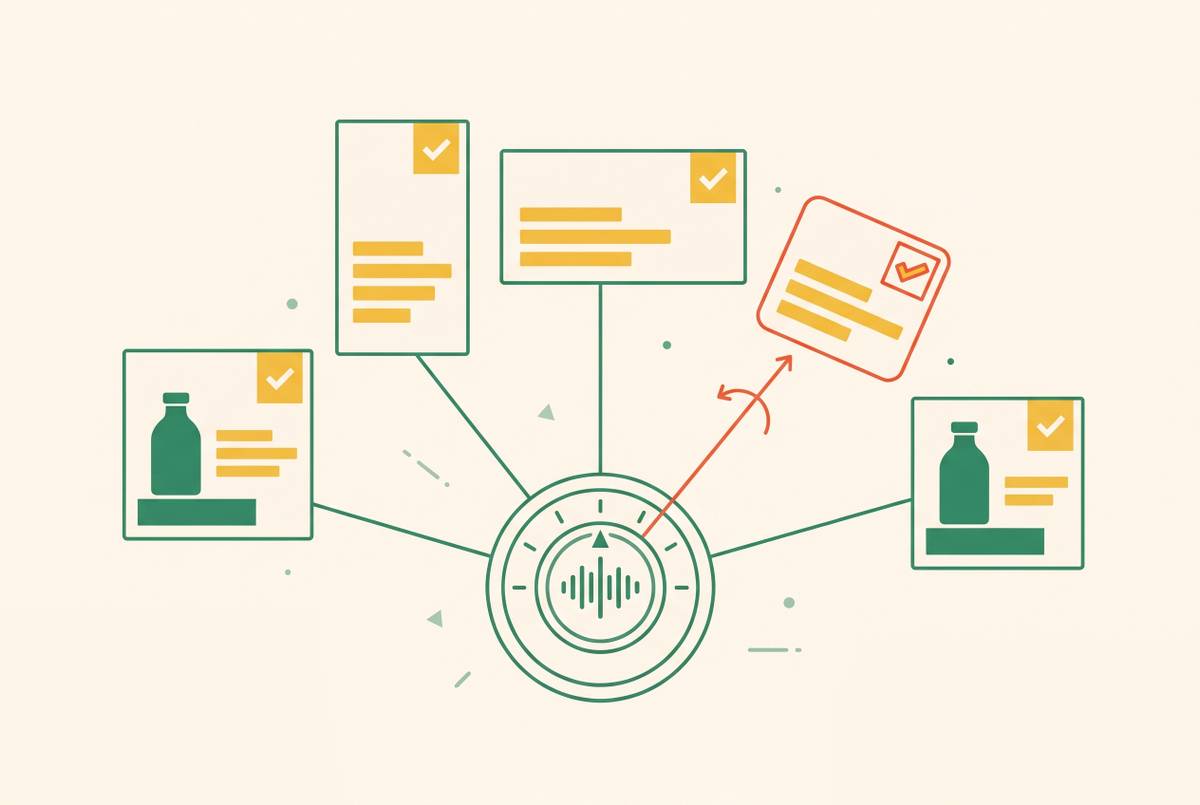
A context-sharing protocol supplies the delivery layer between a governed brand source and an agent working on a task. In this architecture, an assistant such as Claude can query a brand’s MCP server for relevant logo rules, type tokens, color palette, and voice constraints before generating an asset. The context arrives at runtime rather than depending on whatever someone pasted into the prompt. Direct access changes the retrieval path. Instead of reconstructing brand guidance through HTML parsing and indexed fragments, the assistant interacts with data the brand has chosen to expose.
Frontify has shipped an MCP integration layer with ten tool packs for on-brand content creation at scale, with governance and control at its core. Its approach places brand governance at the point of creation as well as after production. Bynder positions its AI agents inside the DAM as the system of record, with centralized global instructions applying across agents. Its controls include role-based permissions, guardrails protecting core brand assets from unintended modification, and audit trails logging every agent action.
Meta’s AI Connectors launched April 29, 2026, supporting campaign creation and management through MCP. Google’s Ads API MCP server, introduced October 2025, at first focused on read-only reporting and campaign diagnostics. The supported operations differ. An MCP connection identifies a way for an agent to interact with a system, with workflows and permissions specific to each connected system.
The April 2026 arXiv analysis AI Identity: Standards, Gaps, and Research Directions for AI Agents identifies unresolved governance gaps when agents cross organizational boundaries through MCP and A2A. These include semantic intent verification, recursive delegation accountability, and governance opacity. Delivery does not settle who may act. Stacklok’s December 2025 survey found that only some technical leaders in the software industry said MCP was widely used in production, while most said security concerns were their biggest obstacle. Teams using MCP for brand context therefore need identity and permissions at the heart of their infrastructure, because a delivery protocol alone cannot set who has authority or ensure that access can be trusted.
Keeping brand context current when the brand changes
A structured feed can become as stale as a PDF. If an agent remains connected to an outdated source, it can generate work that follows rules approved six months ago but no longer in force. Runtime access is useful only when the source itself is current. Versioning establishes the state of the brand rules, while deprecation identifies what should no longer guide production. Propagation then brings those changes to the workflows that depend on them.
The code analogy is precise at this level. Brand identity becomes a living system with an auditable update history, rather than a file replaced without a clear relationship to its predecessors. In the intended architecture, a change reaches downstream consumers so that no connected agent remains on a deprecated branch. The feed model requires infrastructure to maintain the connection between a published authoritative change and its consumers in every workflow.
Atlan’s unified context layer works in a similar way for data. Agents draw from curated context products, shared stores containing governed packages of metadata and definitions. One set of governance policies covers the shared layer. When a definition changes, active metadata management flags and propagates the update to downstream context products and agents. The relevant principle for brand infrastructure is that currency belongs to the common source and its propagation behavior, rather than to each individual prompt author’s memory of the latest revision.
Reviewing AI output against the brand feed rather than against human memory
A structured, authoritative feed gives review a defined reference. Instead of asking whether an output feels consistent with a reviewer’s recollection of the guidelines, a check can compare it with the applicable rules. Visual output can be checked against the token library, and copy can be checked against voice constraints that have been clearly set out. The comparison has an identifiable basis. Generative variability still exists, but deviations no longer have to be discovered solely through familiarity with the brand.
That basis supports automated validation at creation, with human review scaled to risk. Routine social posts can be checked automatically against tokens and voice rules, while high-stakes or regulated content goes to a human. Google’s AI Brief turns brand guidelines into natural language instructions that set rules for AI campaign outputs. Its pre-deployment preview shows sample assets and searches so advertisers can review and iterate before committing. This makes review possible before deployment without treating the first generated result as the final decision.
Bynder’s audit trail makes review a continuous record by logging every agent action so it can be checked. The human role changes accordingly. Brand strategists set standards, define escalation rules, and make final judgments on edge cases, while AI handles volume, checks, and evidence. People still have to judge questions that the evidence cannot settle.
The authoritative source queried during generation also supplies the standard against which the output is assessed. Versioning ties that assessment to the rules that applied, and auditability lets people check how the governed process worked. Review is therefore not a separate workflow bolted onto unrestricted generation.