How DTC Brand Voice Breaks Down When AI Tools Don't Share the Same Creative Ruleset
Separate tool configurations cause voice drift, and one versioned ruleset fixes it.
Detecting when AI output drifts off-brand requires checking spelling, brand terms, and general tone and comparing the output with explicit brand rules. Across a DTC workflow, those checks must use the same current ruleset that governs generation. When each tool holds a separate version, better prompts can improve individual outputs but cannot prevent cross-tool contradiction. A shared, versioned brand context layer addresses that structural failure.
Why DTC brands are experiencing voice drift right now, not five years from now
An entire category can buy the same AI tools, use the same generic prompts, and end up sounding alike. That sameness follows from brands generating content from undifferentiated context. Without the specific rules that distinguish one brand from another, the tools have little basis for preserving those differences. Category sameness is already a workflow problem.
Volume makes that problem harder to contain. A high-performing consumer brand ships ad creative across Meta, Google, TikTok, LinkedIn, and its website, so inconsistent voice can spread across several surfaces at once. Yet the first damage from inconsistent voice is often visible in email flows and review replies, which go out all the time and get checked less closely. These are also places where repeat buyers expect a relationship. Generic copy there breaks an established expectation as well as failing to attract a new customer.
How context starvation, not tool quality, produces inconsistent output
The gap between on-brand and off-brand output depends on the depth and structure of the context available at generation time. Consider a supplement brand asking the same model to write with a “professional” tone. That instruction supplies a broad register, but it says nothing about the brand’s word bans, sentence structure, audience, or channel constraints. The resulting copy can be competent and generic. The model has not received enough information to make more specific choices.
Structured rules for those choices give that model more to work with. It can then write in a defined voice. A persona-specific register tells it how the brand speaks to a given audience, while channel constraints tell it how a product page should differ from an abandoned cart email.
Uploaded samples give it some of that information, but they mostly show patterns such as sentence length, vocabulary frequency, and punctuation habits. They do not necessarily explain why the brand makes those choices or when it makes exceptions. Texture is not the same as a ruleset. The visual equivalent is similarly concrete. Photoroom’s 2026 benchmark found that the best base image-editing model preserved full product details in only about 29% of cases, with failures including warped logos, missing elements, color shifts, and pattern changes.
Why isolated tool-by-tool context makes drift structurally inevitable across a multi-tool workflow
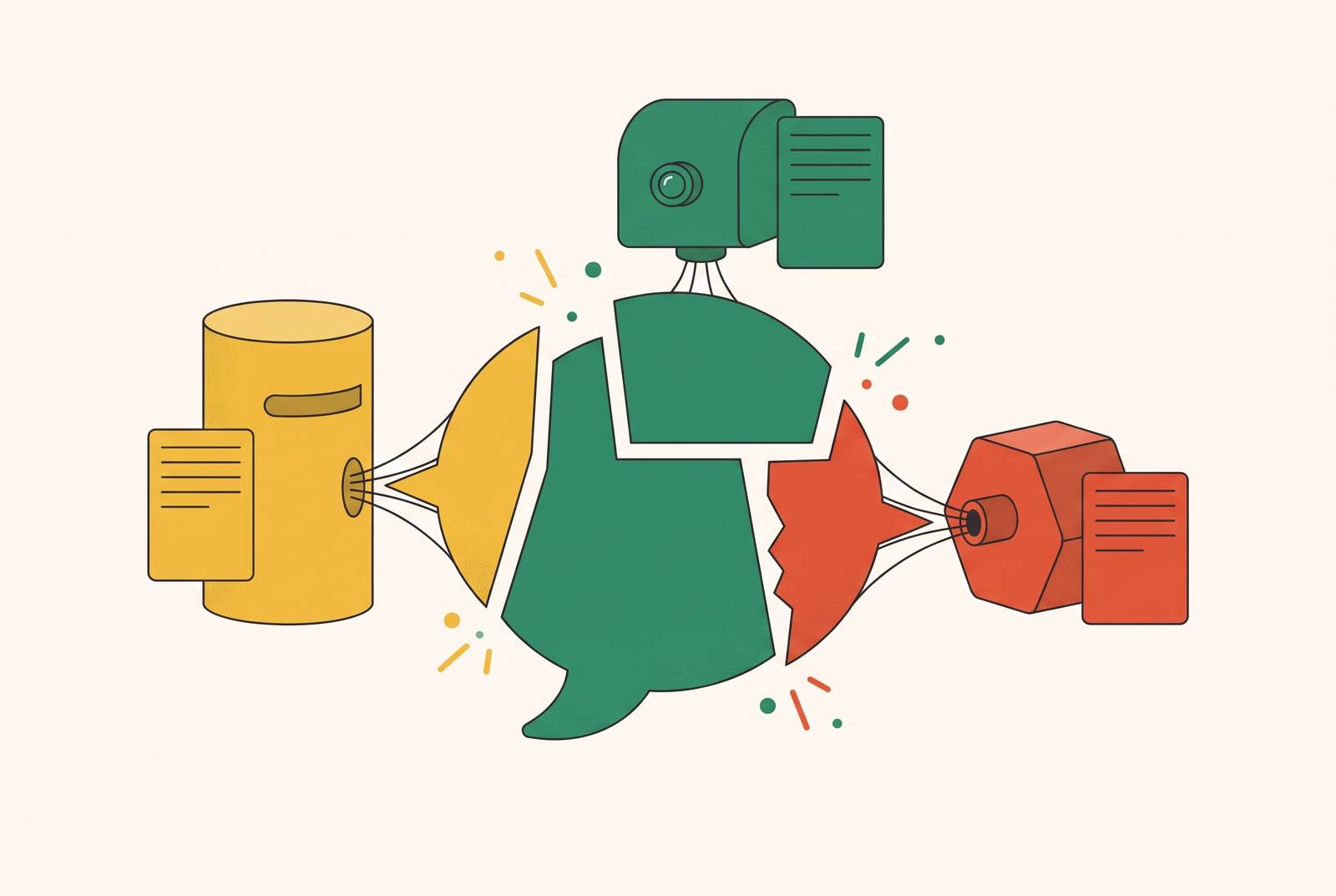
Once several tools participate in production, missing context becomes a synchronization problem as well. An email platform may hold one interpretation of the voice, while an ad creative tool holds another and a social copy tool learns from different samples. Each can follow its own configuration faithfully. The contradiction emerges between them because nothing keeps those configurations aligned with each other or with the brand’s current direction.
Learning within one platform does not close that gap. A correction to email voice does not propagate to the tool generating product descriptions, and an updated ad prompt does not revise the social tool’s assumptions. Local improvements therefore leave the larger workflow fragmented. As the brand changes, each isolated copy can diverge further. The workflow has no shared ground truth against which those copies can be reconciled.
Multi-agent production sharpens the same weakness within a single deliverable. A Researcher Agent, a Copywriter Agent, and a Compliance Agent can each work from different ideas about the brand, even when each does its own task correctly. Their roles do not create a common ruleset. A review that checks spelling and brand terms also leaves the conflict in place, because those checks show whether the words are correct without testing voice consistency.
What happens when brands try to solve this with better per-tool prompts or tool-native memory
Better prompts can improve an individual tool’s output. Tool-native memory can also reduce the need to repeat instructions within a platform. Both are useful local capabilities, but neither synchronizes the other tools in the workflow. Treating them as the complete solution confuses a coordination problem with a prompting problem. A stronger isolated configuration is still isolated.
Meta’s Brand Memory illustrates both the value and the limitation. Nicola Mendelsohn announced it at Cannes Lions on June 23, 2026, as a capability that ingests an existing ad library, learns a brand’s identity and tone, and applies that learning to new generative creative. It is in limited testing. Its reference point is the brand’s past, rather than necessarily its present or intended direction. Learning the average of that history can bring back a general tone and color palette while losing the unusual choices that made some of the work stand out.
That tie to the past can hold a brand back during rebrands, product launches, and cultural moments, when it may choose to move away from its earlier voice. Even successful enforcement within one platform would not transmit the new direction to other tools. Human governance remains necessary here. One named person with final sign-off can establish accountability across surfaces, but a single approval gate cannot match the volume of a modern DTC content operation. More fundamentally, reviewing finished work does not synchronize the context from which it was generated.
What shared brand context looks like as infrastructure rather than per-tool configuration
The structural alternative is a brand context layer maintained outside individual tools and shared by all of them. Its contents include voice constraints, visual identity rules, and positioning, expressed so that an agent can apply them. The source is maintained once. Individual tools draw from it, much as shared code dependencies are maintained centrally across projects.
The rules need to be more exact than those in a typical brand deck. “Friendly” names an impression, but it does not define a behavior that generation or review can reliably test. Machine-readable context specifies which contractions to use, how sentences should open, which words are banned, and how register changes by channel. Persona-aware constraints spell out how those choices change with the audience. Design tokens give the same kind of clear rules for visual work.
The distinction is between interpretation and application. A tool receiving an aspirational adjective must decide for itself what that adjective means, while a tool receiving observable constraints has a defined standard to follow. Versioning makes that standard maintainable as the brand evolves. A voice change updates the shared source, allowing connected tools to draw from the current version. Infrastructure, in this sense, means shared rules with an explicit place to maintain them.
How MCP is making shared brand context technically connectable across agents and tools
Model Context Protocol, or MCP, provides a way for multiple compatible tools and agents to reach that shared source without a separate one-off integration for each connection. MCP supplies the connection to the creative rules. Its role is to make the same context reachable across a workflow, so that sharing a standard does not depend on manually copying it into every platform.
Knak shipped its MCP Server in April 2026 so AI assistants could connect to brands, campaigns, and themes to make email assets ready for production. Those assets use the same rendering pipeline as its visual editor. HubSpot made its remote MCP server generally available to all HubSpot accounts on April 13, 2026, with read and write access. Adobe Marketo Engage launched its MCP server in beta in April 2026, reaching general availability in October 2026, with operations across forms, programs, smart campaigns, leads, emails, snippets, lists, and folders.
The July 28, 2026 MCP specification moved the protocol to a stateless core and tightened authorization, allowing servers to scale more easily behind ordinary load balancers. The brand’s rules are still in their shared source. For a DTC workflow, the practical implication is that an AI writing assistant, campaign tool, design tool, and email platform can access the same current guidelines, provided they support the connection. Protocol support lets the tools connect, but the rules still need to be complete.
How a DTC team detects off-brand AI output in a shared-context workflow
A DTC team using this architecture maintains one source of truth for voice, visual identity, and positioning. Its tools connect to that source at generation time rather than relying on separately maintained prompt fragments. The same source also anchors the review step.
For a team setting up detection, the lesson is to turn each documented rule into a specific comparison against the finished output. A word-ban check finds words the brand has banned, while a sentence-structure check tests the copy against the brand’s rules for how to build sentences. Channel-register and persona checks test whether the language fits both the surface and the audience it is meant for. Each check needs evidence from the output. A general pass or fail based on how the copy feels cannot show which constraint was followed or violated.
An abandoned cart email can contain no spelling errors and still fail because it uses a product page register. Conversely, differences between those channels can be correct when the shared rules explicitly call for them. The standard is documented behavior. When a launch or rebrand changes that behavior, the team updates the source once so that connected tools and review use the new version.
Maven Clinic illustrates a complementary custom-model path for visual production. When it rebranded and needed fresh marketing materials, Superside trained a custom AI image model on curated on-brand examples and delivered an on-brand Figma plugin, substantially reducing production cost compared with traditional shoots. The model’s reference was the brand’s actual visual standards. Knak illustrates the shared-context principle in templated production instead, where assistants connect to brands and campaigns at generation time. Email assets can then get their context through the workflow, so each asset no longer needs a fresh prompt.
Why consistency and distinctiveness are not the same problem, and shared context protects both
A perfectly consistent brand can still be forgettable. Consistency comes from outputs following the same standard, while distinctiveness comes from what is in that standard. If the shared source has only safe, generic tone labels, every connected tool can follow them and still make nothing that people would recognize as the brand. The creative work lies in documenting the specific, ownable constraints that distinguish the brand.
Memory infers patterns from what a brand has produced, which can privilege the average over its more unusual choices. A shared context layer instead holds the rules the brand intends to use now, including deliberate departures from its history. That distinction preserves room for evolution. It also allows distinctive choices to be expressed as constraints rather than left to a model’s interpretation of old examples.
Channel-specific register shifts and persona-aware constraints can preserve variation within a recognizable identity. The shared layer defines which differences are intentional. Without it, reviewers must distinguish creative variation from accidental drift after tools have already generated from incompatible assumptions. The decisive question for a DTC team is whether its AI tools share the brand’s current creative rules.