When DTC AI Output Loses Your Brand Voice the Fix Lives Upstream of the Copy
Shared brand context upstream prevents AI from drifting off-brand across every agent and surface.
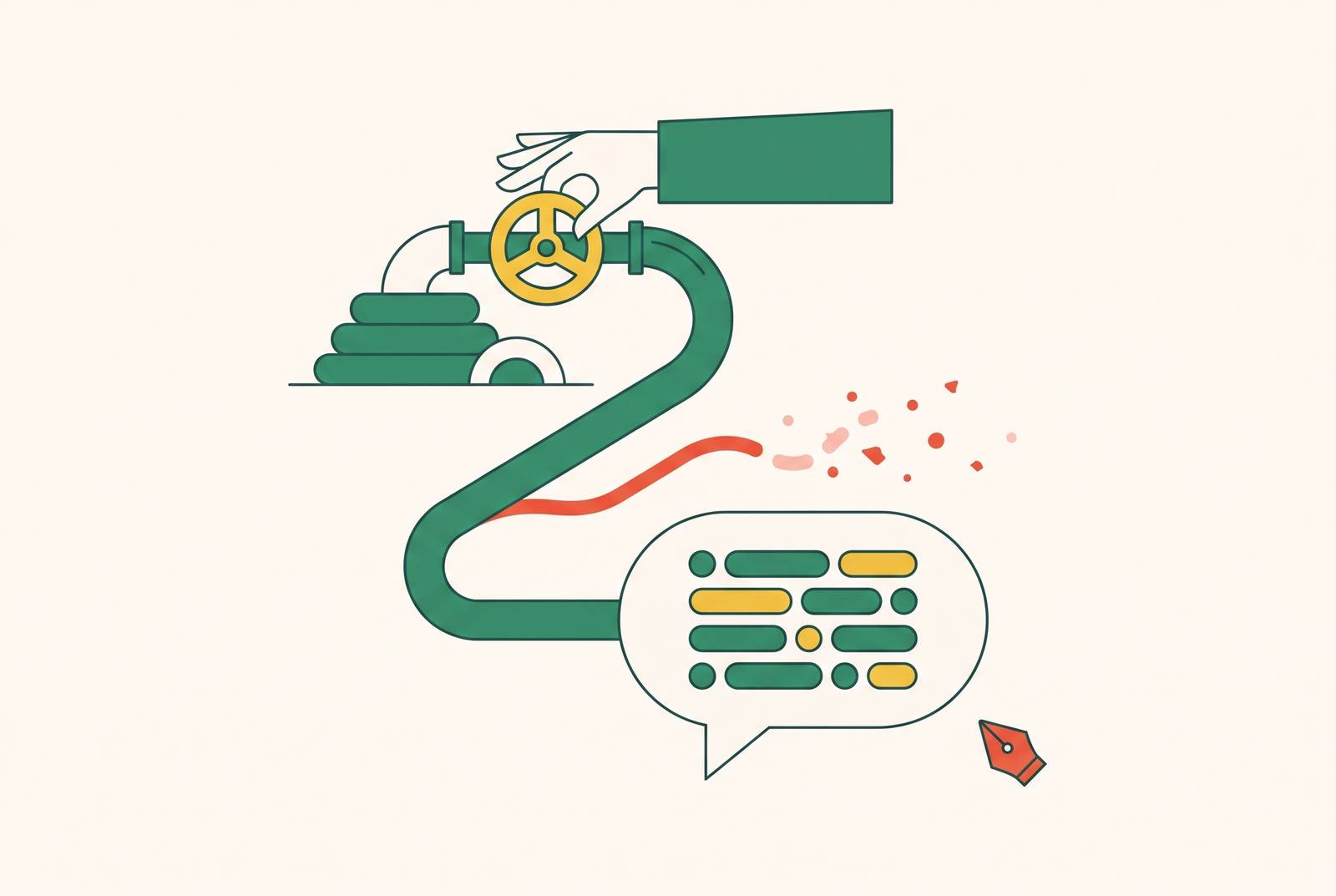
Detecting when DTC AI output drifts off-brand requires comparing its vocabulary, tone, positioning, and channel fit against approved brand context. To prevent that drift, every agent needs the same structured, versioned context before it generates copy. When output loses the brand’s voice, the highest-leverage fix lives upstream of the copy.
Why DTC brands all sound the same now, and why AI is not the root cause
DTC brands have bought the same AI tools, written the same prompts, and started making content that sounds like the same person speaking across categories. AI adoption is now universal among DTC advertisers, so access to generation differentiates no one. Without distinctive input, greater production capacity gives brands more opportunities to sound interchangeable.
That convergence exposes a failure that predates AI. A majority of marketing materials already failed to conform to brand guidelines, and most companies struggled with off-brand content despite documenting their identities. Those documents were aspirational rather than operational. They described the intended brand without reliably governing the work produced in its name.
AI scaled that gap at the verbal layer. Teams say that logos, colors, and visual layouts stay consistent when AI does the work, while the words lose the brand’s voice. Correcting individual sentences addresses the visible symptom, but leaves the next generation call working from the same weak foundation.
How do you detect when AI output drifts off-brand?
The clearest detection signals are generic vocabulary in place of an approved lexicon, tone that conflicts with approved examples, positioning that loses the brand’s specific stance, and language unsuited to the channel or audience. Fluency is not evidence of brand fit. An agent can produce accurate, readable copy that fails all of those tests because it has no authoritative context against which to make its choices.
The first commercial consequence is lost trust. When shoppers recognize AI content, they distrust the brand far more often than they trust it more. The most AI-fluent shoppers, who also buy the most, notice most often. Most readers who suspect AI-written content engage less with it, so generic output can hurt revenue as well as the quality of the creative work.
The least-reviewed surfaces compound that exposure. Support macros, shipping notifications, and review replies ship constantly, often to repeat buyers who already know how the brand should sound. Editors may review a campaign closely while everyday messages keep straying from the voice that earned the customer’s trust.
AI search adds a less visible consequence. Inconsistent descriptions across a brand’s pages and third-party mentions can weaken how AI platforms synthesize its identity and represent it in recommendations. This extends beyond stylistic polish into positioning. AI-generated descriptions that get the brand wrong have already cost brands customer relationships, so the context needs to be sound even for copy outside the brand’s own channels.
Why brand guidelines fail as agent inputs
Most brand guidelines ask their reader to interpret. Words such as “friendly,” “authoritative,” and “approachable” work as human shorthand, but they do not specify the choices an agent should make in a particular message. Many brands claim the same adjectives. Those descriptions cannot, by themselves, explain what makes one brand’s authority different from another’s or how its friendliness should change between a campaign and a support reply.
Agents need the missing distinctions made explicit. Rules set limits, approved examples show how to work within them, and paired on-brand and off-brand samples show where those limits are. Channel-specific variations then connect those distinctions to the task. Together, these inputs give an agent something more usable than a description that still requires it to infer the brand’s intent.
Pasting a guideline into every prompt only partly addresses the problem. Each new conversation starts again, corrections recur, and quality depends on who remembered to include which material. The process has no dependable shared foundation. The failure is therefore neither the guideline nor the agent alone, but the absence of a translation layer between human brand identity and the context an agent can consume before generating.
What machine-readable brand context actually looks like
A complete machine-readable identity has five layers, each with its own job. The identity layer holds fixed visual facts, including logos, colors, type, and shapes. The style layer has visual references, guidance on images, and examples of treatments. These layers establish the visual basis for production without asking an agent to reconstruct it from scattered assets.
The narrative layer makes verbal identity operational. It includes system prompts, tone of voice, an approved lexicon, and paired on-brand and off-brand samples. The context layer specifies how those choices vary by channel, format, audience segment, and funnel stage. An email sequence and a launch deck need not sound identical to belong recognizably to the same brand.
The governance layer controls approval workflows, usage rights, and versioning. When identity changes, agents that use static documents keep the old guidance, while a shared, versioned system gets updates to the agents connected to it. Without that layer, even well-structured guidance can split into versions that conflict with each other.
The descriptive document still serves human readers. A living file of approved examples and paired samples gives machines a more precise basis for execution, which is how top-performing brands distinguish their approach. Treating the brand as an API means making prices, product specifications, voice rules, and positioning readable and queryable. It is an operational requirement.
How MCP changes where brand context lives in the agent workflow
The Model Context Protocol, or MCP, gives agents that support it a standard way to query shared context before they generate content. Rather than rebuilding the brand inside each conversation, the workflow draws from a persistent source. This changes where the dependency sits. Brand guidance becomes part of the agent’s working inputs rather than an optional attachment supplied by the person writing the prompt.
Anthropic standardized MCP in November 2024 and donated it to the Linux Foundation’s Agentic AI Foundation in December 2025. With major platform backing, the protocol is cross-vendor infrastructure. Amazon Ads launched its MCP server in open beta on February 2, 2026, illustrating how a single prompt can trigger orchestrated, multi-step workflows.
Meta’s Brand Memory offers a useful contrast. Drawing on a brand’s advertising history can preserve its palette and general tone, but can also pull creative output toward the average of that history. Platform-level memory has a defined boundary. It cannot hold brand context outside the ad library or propagate an identity update to agents on other platforms. Meta’s Creative Approval Flow was still in testing at announcement, so the associated safety mechanism was not fully shipped as generation scaled.
Use Meta’s tools with an understanding of that boundary. A support copilot and a campaign agent need access to the same authoritative identity even when they operate on different platforms. Separate memories create divergent interpretations and duplicate governance work. MCP makes shared access practical, while the quality and completeness of the context remain the brand’s responsibility.
Putting shared brand context into practice across agents and surfaces
For practitioners, the workflow begins by structuring identity through the five-layer model and storing it somewhere agents can query. A website, brand guide, or set of files can supply the starting material. Those inputs still need an operational structure. Connecting agents over MCP or an API then makes that shared brand layer part of generation rather than something each prompt author must reconstruct.
The system should use that context to write a brief for each task. A campaign image, launch deck, and email sequence require different combinations of logo rules, type, colors, imagery, and voice parameters. Relevance reduces the need for interpretation. The purpose is not to paste the entire guideline into every request, but to supply the constraints and examples that govern the particular work.
Before the work is published, reviewers should check it against the versioned context used to generate it. The practical audit criteria are approved vocabulary, alignment with on-brand examples, compliance with explicit rules, and fit with the channel, audience, and format. Each check needs evidence from the output and the relevant guidance. This distinguishes a structured audit from an editorial reaction that something simply “does not sound right.”
When identity changes, the central version should change so the agents and products connected to it get the update. People still need to oversee the work, with one person in charge of final sign-off across surfaces. Agency and multi-brand teams also need a separate, versioned context for each brand. An agent working from the wrong client’s identity can spread that error through every derivative, making correct context selection as important as access to context at all.
The objection worth taking seriously: consistency is not the same as distinctiveness
A system can produce consistent work that remains unremarkable. Brand infrastructure solves the problem of shared guidance, but it does not automatically make that guidance distinctive. The objection is valid. If the source contains only familiar adjectives and broadly acceptable examples, reliable execution can make a brand uniformly generic.
Meta’s Brand Memory illustrates the tension directly. A system drawing on a brand’s history can capture the palette and general tone while smoothing away the founder-led specifics that made the work stand out. Historical averages are not a creative identity. The structured context needs the vocabulary only that brand uses, the positions it alone holds, and choices specific enough to be wrong for a competitor.
Retain the infrastructure and enrich its context by combining explicit rules with the ownable, slightly unusual details that make the brand difficult to substitute. An agent can use the same context each time, while a person’s work may drift from one piece to the next. That repeatability is useful only when the source preserves the brand’s edges.
Governance must also leave room for those features to change. Most teams lack one person with final sign-off across every surface, and multi-agent work increases the risk of divergent interpretation. Shared context lowers that risk, while people still have a role in the work. Versioning then gives approved changes a route into future work, so distinctiveness stays current instead of becoming a fixed imitation of the brand’s past.
Where to start: the one change that shifts voice from prompt-dependent to infrastructure-driven
The first move is to audit what agents can currently access. If their brand knowledge consists of whatever someone pastes into a prompt, there is no dependable upstream context layer. That is the gap to address first. Rewriting prompts or editing the copy again cannot take the place of a source that every agent doing the work can consult.
Support macros, transactional email flows, and review replies are good places to start because so many go out with so little oversight. The audit should check their output against the approved vocabulary, paired examples, clear rules, and requirements for each channel. Evidence should identify the actual departure. That makes the review useful for locating missing guidance as well as rejecting unsuitable output.
The brand identity should then be structured before agents connect to it. A queryable but poorly defined identity only makes consistent errors easier to produce. Once the source is ready, MCP or an API can give relevant agents shared access, with review built into the workflow before publication. The decisive change is that brand voice no longer depends on who wrote the prompt or remembered the latest correction.